YSI INET

Blog

  • Highway to hell: How neoliberalism is driving “advanced” economies towards a Latin American-style accumulation pattern

    By Baptiste Albertone

    The weight of the past has sometimes been more present than the present itself. And a repetition of the past has sometimes seemed to be the only foreseeable future. 

    Enrique Krauze

    The history of independence in Latin America is a history of reproduction of the same, but different. The Napoleonic wars that weakened the Crown provided the opportunity for Latin American landlords to finally claim the full possession and administration of the fertile soil and abundant cheap labour at their disposal. As the first nations proclaimed their right to self-determination, the new states engaged in the consolidation of a new institutional framework, independent of the Crown, but reconfigured to fit the taste and interests of landed-elites and the colonial bourgeoisie. As it is common in the revolutionary processes of nations under colonial rule, despite the adhesion and (indispensable) active participation of the popular sectors, only a segment of the elite benefited from the structural reconfiguration of what the Marxist literature calls: a Bourgeois revolution.

    The political rupture translated into economic continuity: The regime of accumulation inherited from the colonial period remained unaltered to reproduce a rentier-style capitalism. Indeed, the material reason for independence was not the transformation of the economic structure but the conquest of a larger share of its benefits by one class.  In addition to internal interests, a parallel international driving force supported the maintenance of this rentier regime: the centro-peripheral dynamics of the world economy, which placed Latin American nations in a subordinate and “dependent”  condition of natural resource providers for “core” economies. 

    The role of economic ideas has certainly been decisive in the ability of the rentier regime to reproduce itself despite its deleterious effects. First, in the post-independence period, the neoclassical theory of comparative advantage offered a strong argument against developing a manufacturing sector through industrial policy. Later, in the early post-war years, the US administration-backed modernization theoryacted as a strong counter-discourse to classical development theorists’ arguments in favour of a structural transformation. Finally, from the late 1970’s onward, the infamous Washington Consensus came to provide an intellectual rationale to the political and historical project of capital and power concentration with de-industrialisation in the Latin American continent.

    The socio-economic consequences of the rentier developmental mode are profound. As the Latin American structuralist school has vastly discussed, the rent-seeking style of development has favoured the persistence of 1) a large pre-capitalist sector, and 2) a highly heterogeneous intersectoral productivity. These structural determinants have major consequences on both pre-tax and post-tax income inequality dynamics. First, the economic dualism of the productive structure, a feature of rentier capitalism, implies that the share of labour in national income is very low In fact, land concentration and the scarcity of productive employment produce structurally unequal labour markets, with a very high number of informal workers acting as a reserve army. Second, the absence of a meaningful social contract between the governing elites and the popular sector gives rise to a regressive and fragile fiscal state, reluctant to influence the structural level of inequalities and to finance public goods. 

    Therefore, the Latin American state was designed in such a way to guarantee the reproduction and the capture of the benefits of economic development by a wealthy minority, echoing Smith’s view that “[c]ivil government (…) is in reality instituted for the defence of the rich against the poor, or of those who have some property against those who have none at all”.

    The so-called era of democratisation in Latin America did not alter these power asymmetries. The structural configuration of extreme wealth and income inequalities as well as an almost unlimited ability to match economic power with political power gave rise to a form of quintessential Neoliberal state where, in José Gabriel Palma’s words the “new ‘democratic’ agenda of capital ensures that the state will fulfill its sole function of reproducing the new capitalist system”. The consequence is a unique level of inequality characterised by an unrestricted capacity of the elites to perpetuate themselves despite political changes.

    But if the recipe for Latin American success once appeared to be a well-kept secret – only shared with some South African nations – it may no longer be the case. The neoliberal revolution that successfully altered labour markets and fiscal structures of most OECD countries is producing what Palma describes as a form of “reverse catching up”, with some advanced economies moving towards a Latin American style of accumulation. 

    The graphs below illustrate the evolution of pre-tax inequalities in Germany, the United States, and the United Kingdom, three of the countries most affected by Neoliberal — or Ordoliberal in the German case — reforms.
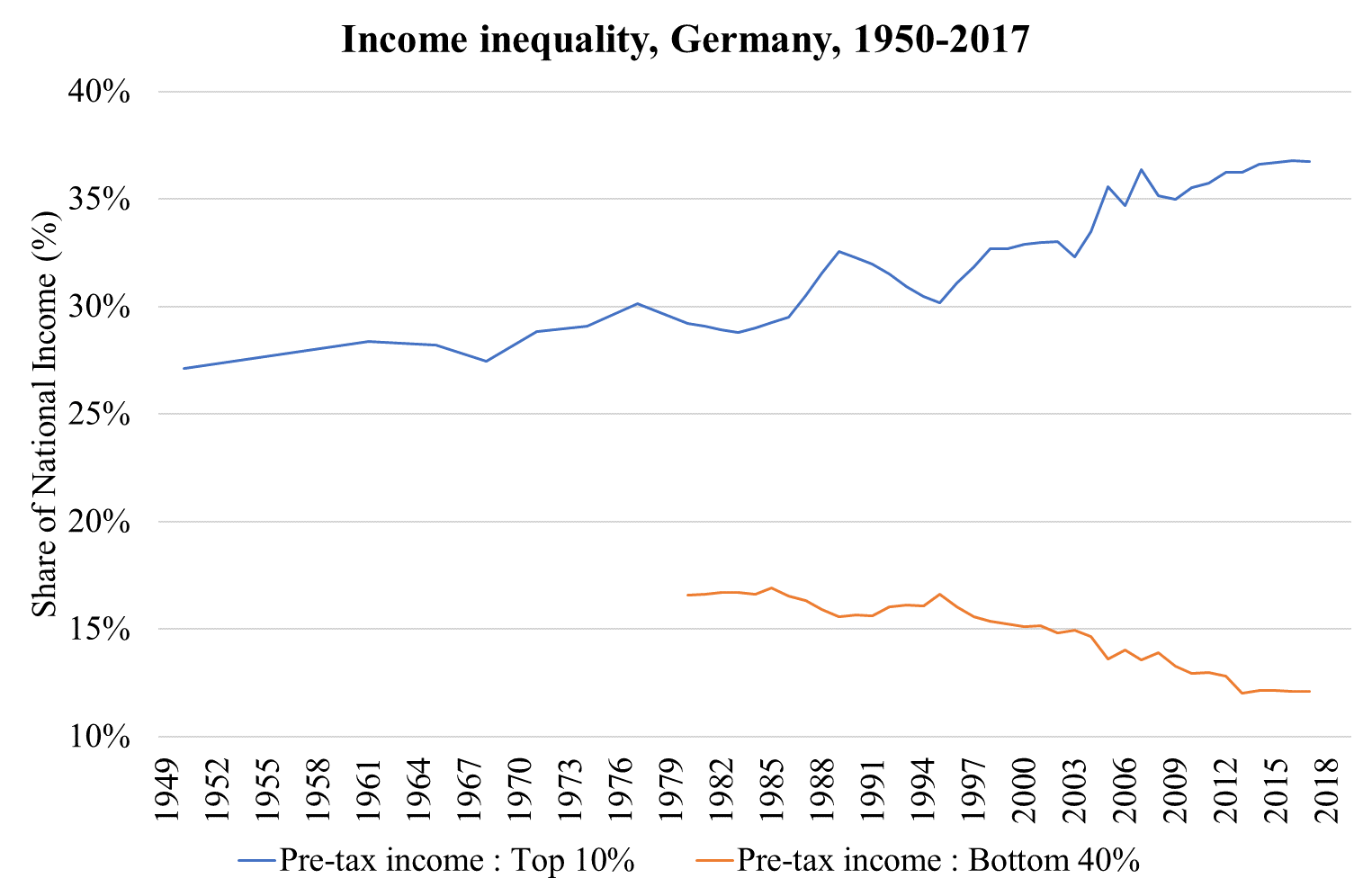
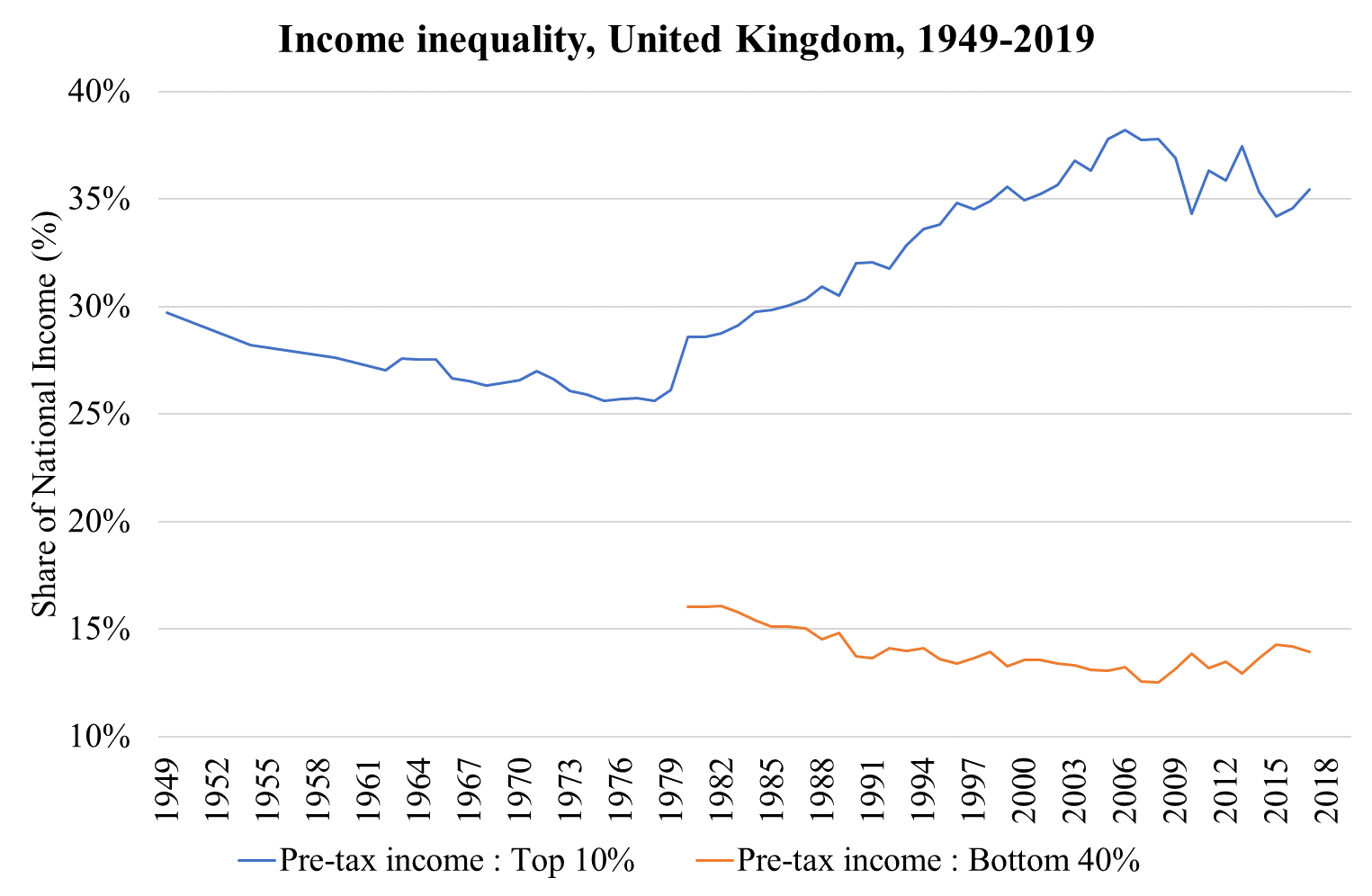
    Since the 1980s, these countries have experienced a dramatic rise in the share of the national income going to the individuals in the top 10% of the income distribution, mirrored by an almost identical, but opposite, trend affecting the share held by the bottom 40%. These tendencies are certainly not independent of the political and economic context that characterised the period.

    From the mainstream viewpoint, the justification given for the tragic evolution of inequality is that of an growing capital-output ratio driven by entrepreneurial investment leading to an elevation in the share of profits in national income. 

    Nonetheless, when looking at real investments’ figures, the picture turns out to be dramatically different from the expected dynamic. In the US, the gross private investment share of GDP has fallen by 3 percentage points since the late 1970s. On the contrary, what we see is a growing capacity from corporate elites to capture the benefits of economic growth with the help of both globalisation and financialization dynamics. Consequently, between the mid-1970’s and 2017, while real US GDP did more than triple, the real hourly wage of most Americans stagnated. 

    What is at stake is a reconfiguration of the political space in the image of the Latin American oligarchical institutional style, where hierarchical economic principles subordinate the democratic and representative principles of politics embodied in the figure of the State. According to Branko Milanovic, the neoliberal restructuring while “it maintained the pretence of equality (one-person one-vote), (…) eroded it through the ability of the rich to select, fund, and make elect the politicians friendly to their interests”. In other words, neoliberalism should be understood as an active project that, as Quinn Slobodian notes it, “rather than ‘freeing’ or ‘disembodying’ ‘the’ market, [attempt] an ‘encasement’ of economic structures, isolating them from popular democratic demands”. 

    By weakening the power of labour with more flexible workers’ protection, unravelling the Welfare State where it existed, engaging in a privatisation of public goods — the capital of those who don’t have any —, by adopting tax reforms that enhance regressive taxation and tax evasion, and by globally consolidating what Slobodian calls “the human right of capital flight”, neoliberalism demonstrated its striking effectiveness as a “technology of power” to rewrite the rules of the game in favour of capital accumulation. In the same way as Latin-American elites structured the newly born nation for the benefits of their interests, the recent success of Northern capitalist elites to create an environment suitable for the flourishing of their rent-extraction ambitions.

    The structural reconfiguration that has been taking place since the mid-1970s is simultaneously endangering social and ecological balances, as well as putting societies at risk of implosion under authoritarian governments eager to establish Neoliberalism in a single country. We might be heading towards a dark horizon sketched by Slobodian as one of “brute competition in a zero-sum world where all that matters is the enrichment of an ethnically defined, territorially bounded national population”, where the protection of the environment – a common good by definition – is relegated to the tenebrous depths of national political agenda.

    From this frightening observation arises an unsurpassable necessity to engage in a struggle for the transformation of economics — which today serves under its technocratic authority as the core instrument of the corporate elites’ political project — so that it becomes a democratic instrument for a fair and ecological economic transformation.


    About the author: Baptiste Albertone is an MPhil candidate in Development Studies at the University of Cambridge and holds an MA and BA from the Institut d’Etudes Politiques de Paris. His research focuses on industrial policy and sustainable development in the Latin American context. Twitter: @BaptAlbertone 

    This article is a runner up in an essay competition held by the UNCTAD YSI Summer School on Globalization and Development Strategies. Participants of the school worked with senior scholars to fine-tune their drafts, and the top-5 articles were published here. For other articles in the series, please click here.

    About UNCTAD UNCTAD is a permanent intergovernmental body established by the United Nations General Assembly in 1964. Its headquarters are located in Geneva, Switzerland, with offices in New York and Addis Ababa. UNCTAD is part of the UN Secretariat, reports to the UN General Assembly and the Economic and Social Council, and are also part of the United Nations Development Group.

  • New Economics for Sustainable Development: Alternative economic models and concepts

    By Dr. Chantal Line Carpentier

    The widespread neoliberal model and the financialization of the economy is linked to the skewed system by which production factors are rewarded, whereby increasingly the lion’s share of income generated is going to reward capital compared to labor thereby increasing inequalities. While the maximization of profits at-all-costs economic model and its linear consumption and production patterns of “take, make, use, and dispose” are leading the rise of greenhouse gas emissions, biodiversity and ecosystems loss, and water, soil, and ocean depletion. The pandemic has exposed the interdependence and fragility of the economic, financial, environmental, and health aspects of human life, as well as the interrelation among these four dimensions as we meet increased material demand by encroaching on the last forested frontiers leading to increasing zoonoses. 

    The Sustainable Development Goals (SDGs) and the Addis Ababa Action Agenda for Financing for Development (FfD) adopted  unanimously by all UN member States in 2015take into account these interconnections and thus provide roadmaps, principles, and means to channel previously unavailable funds that are being rolled out by governments and international organizations to support collapsing economies. These trillions in public funds that just materialized must help advance the transition to economic models compatible with the SDGs – already not on track to be met prior to the pandemic according to the Global Sustainable Development Report 2019. The transition is feasible within the planetary boundaries but we need new economic and financial models. UNCTAD has called for a Global Green New Deal (GGND) but it turns out that blue, orange, purple, and yellow economies together have a better chance to rebuild resilient, inclusive, and more equitable economies. And this is in line with requests made by UN member states that the United Nations ensure its work is tailored to the different contexts in which it operates.

    The Green New Deal extends the US “New Deal” approach of massively investing in infrastructure projects to create jobs and get the US economy out of the Great Depression, to target jobs in the green and new economy sectors such as resilient construction, decarbonized energy, clean transport, and sustainable agriculture and cities. The Global Green New Deal (GGND) proposed by UNCTAD crucially includes an equality and equity dimension. Under the GGND, the international community would have to address the root causes of inequality. Spurred by international solidarity and the realization that our economic, health, and political systems are interdependent, developed nations should not only fund their green, blue, orange, purple, or yellow economic stimulus but also support that of developing countries. This would allow developing countries, where most new infrastructure is being built, to use circular economy principles, avoid investing in stranded assets, whilst generating jobs to help workers’ transitions to the new economy, such as from fossil fuels to renewables energy. 

    The circular economy uses science, technology, and innovation to increase efficiency by designing for recyclability and re-use at the end-of-product lifecycle and cutting out waste and pollution from production systems. It aims to produce more with less waste, resources, and energy through a make-use-recycle-reuse circular pattern. Many countries have embraced the concept. For instance, Uganda does so by using biogas technology, e-waste management, organic agriculture, green manufacturing, and eco-industrial parks.  New business and distribution models are needed to achieve deployment at scale.

    A related concept is “frugal innovation” whereby the aim is to do “better with less”. A frugal mindset creatively builds upon and repurposes existing technology and innovation and aims to provide low-cost, high-quality solutions to the most pressing issues of the world; it is thus more likely to view inequalities and climate change, and other social and environmental issues as business opportunities. The pandemic has accelerated the digitalization of the economy and the use of automation and artificial intelligence. In this sense, policies and fiscal stimulus that incentivize frugal innovations could accelerate deployment. While better reuse of agricultural and other scrap materials, as well as investment in rural infrastructure, could scale up access to basic services such as water, sanitation, and energy to previously un- or under-served populations while fostering rural MSMEs and job creation. 

    The Blue Economy is the green economy concept adapted to the ocean economy that could benefit many Small Island Developing States (SIDS) with massive ocean resources and developing countries with long coastal areas.

    Similarly, the creative or orange economy, which relies more on human capital and ICTs, can support youth entrepreneurship and job creation. The orange economy is the trade, labor, and production of the creative industries, such as advertising, design, publishing, software, Film/TV/Radio. It requires a labor force with the ability to think and act creatively. The creative economy supports sustainable entrepreneurship and empowers innovators, especially the generation that grew up in the digital era. Marketing, fashion, or media companies also influence values and consumption, and lifestyle choices as they are often operated by young people who tend to be purpose-driven and support sustainability. A dynamic creative economy can thus play a vital role in promoting other alternative economic models, especially in developing countries.

    The yellow or Attention Economy is the monetization of consumer’s attention by platforms such as Google, Facebook, Instagram, Snapchat, Twitter, Tik Tok among others by collecting vast amounts of information on consumers. They monetize this information by developing increasingly sophisticated algorithms and persuasion techniques to keep people clicking scrolling, and sharing. These techniques prey on many of human core subconscious tendencies for pleasure or fear to trap people’s attention and alter human behavior or perception. This market, valued in the trillions of dollars, is increasingly believed to be sowing the increased polarization, extremism, and radicalization being observed currently.

    However, if harnessed, the Attention Economy could become a powerful tool to effectuate the necessary behavioral changes needed to transition towards the world we want, thriving in authentic mutual connection by using technology to bring humanity back into alignment with the rest of nature and the SDGs.

    It is also an opportunity to build their care economy while creating more decent jobs and addressing gender inequalities. The care or “purple economy” – with investment in education and health providers for children, elderly, people with disabilities – would create 2.5 times more  jobs than investment in physical infrastructure, create 30 times more jobs for women, and ease restriction on women’s time, and have greater and fiscal sustainability

    To be even more inclusive and resilient, in line with the 2030 Agenda, these models could be supported by the Social and Solidarity Economy Organizations and Enterprises (SSEOEs). The Social and Solidarity Economy (SSE) is people-centered, addresses exclusion by reaching-out and incorporating marginalized groups in supply chains and facilitating their vertical integration into the larger economy. SSE also fosters shared prosperity through shared ownership of assets and means of production. It also promotes active citizenship, participatory democracy, and a pluralistic economy which bolsters social cohesion, accountability, and sound governance (SDG16).  

    SSEOEs include worker, producer, and housing cooperatives that share the features of joint ownership and democratic governance. Being an integral part of their communities, these organizations also have a stake in ensuring the social and ecological integrity of their host communities in the short and long term, which is not necessarily the case for publicly listed or privately-owned companies. Moreover, cooperatives have shown to be a prolific job creator as an estimated 9.5 percent of the world’s working population are employed by cooperatives.

    We cannot afford to waste another crisis. The pandemic is and will be costly. Funding the transition to green, blue, orange, and purple economies is feasible! We have a duty to use the trillions that have materialized to jump-start and accelerate the transition to new economic models that can tackle the complex interdependencies among the SDGs. If international solidarity is not sufficient justification to support developing countries, the interconnectedness of our health and the ecosystem demonstrated by the pandemic should be. 


    About the author: Chantal Line Carpentier is the Chief of the UNCTAD New York Office of the Secretary-General. The views expressed in this publication/study are those of the authors and do not necessarily reflect those of the United Nations including the UN Conference on Trade and Development.  This article builds on a draft developed with Raymond Landveld and Olivier Combe, Economic Affairs Officers in the UNCTAD New York office. 

    This article is a runner up in an essay competition held by the UNCTAD YSI Summer School on Globalization and Development Strategies. Participants of the school worked with senior scholars to fine-tune their drafts, and the top-5 articles were published here. For other articles in the series, please click here.

    About UNCTAD UNCTAD is a permanent intergovernmental body established by the United Nations General Assembly in 1964. Its headquarters are located in Geneva, Switzerland, with offices in New York and Addis Ababa. UNCTAD is part of the UN Secretariat, reports to the UN General Assembly and the Economic and Social Council, and are also part of the United Nations Development Group.


  • Responsibility Shifting in Investment and Sustainability

    By Soo-hyun Lee

    When it comes to understanding the relationship between investment and sustainability, national and international governance institutions take a facilitative rather than regulatory approach. 

    This is largely premised on two assumptions: (1) overreach would result in regulatory chilling that could limit investment and (2) regulating investment inflows would limit their potential economic impact. Though taking place in different forms between portfolio investments and foreign direct investment, a facilitative approach, in principle, shifts the responsibility of defining and understanding the interplay between investment and sustainability to market interactions: between the investor and the recipient. 

    Assessing the facilitative approach to investment and sustainability within the microeconomics of sustainable development policy renders some noteworthy observations. Namely, creating a regulatory and governance environment that facilitates the consumer and producer, or in this case the recipient and the investor, shifts responsibility away from the government or prevailing institution from taking a more prescriptive approach: defining, implementing and enforcing a more substantial linkage between investment and sustainability.

    A prescriptive role, while more vulnerable to the potential consequences of regulatory chill, may be necessary to administering the nexus between investment and sustainability because sustainability as a motivating factor does not naturally arise from the economic rationality that fuels market interactions. The relationship between investors and the recipients of investment, just as that between producers and consumers, does not function on the logic of advancing sustainability, but rather economic profit maximization. For this reason, should their interaction deviate from this core market-based logic by, for example, running deficits in consumer and/or producer surplus, or being involved in investments where risk supersedes returns, their interaction is jeopardized and likely to be discontinued. For that reason, shifting the responsibility to the consumer to fuse a more molecular bond between investment and sustainability seems destined to meet an inconclusive outcome as it saps away the essential motivation to shoulder that burden both materially in terms of resource allocation and substantively as a determination to form a meaningful investment and sustainability nexus.

    Turning to views in sustainable consumption, Mont, et al (2013) identifies a similar paradox in their work for the Nordic Council of Ministers based on interviews with policymakers as a myth of sustainable consumption. They write that shifting the responsibility of sustainable consumption to the consumer limits state involvement to raising awareness rather than taking more proactive interventions against unsustainable consumption. The inherent problem behind shifting responsibility, they write, is that consumer behaviour is based on contextual factors that are “beyond the control of individual actors”, namely prevailing social norms that shape a consumer’s understanding of consumption in connection to sustainability. Presently, this norm is that sustainable consumption is an extraordinary decision that requires justification (Mont, et al, 35-37) as it deviates from market-based reasoning. The consumer requires additional justification for these decisions to justify that divergence: why to choose a product that provides comparatively less consumer surplus by paying a higher price or paying a price to receive less utility arising from consumption?

    Lorek and Spangenberg (2013) explains responsibility shifting in sustainable consumption as the lock-in situation, where transitions to sustainability is contingent on more growth and technological innovation. This is reflected through the I = P*A*T equation, which offsets the added cumulative climate impact (I) as the function of the factor of population growth (P) and greater per capita affluence (A) by technological progress (T). With advances in (T), higher unsustainability derived from increasing (P) and (A) values are offset by technologies that enhance the sustainability of consumption. Herein lies one of the causes behind responsibility shifting, which is a “technological optimism” that firms will advance the state of technology if given the means to do so (Lorek and Spangenberg, 35). The central economic tenet behind this technological optimism is economic liberalism, which attributes the agency and primacy of economic optimality to market-based actors, in turn manifesting external intervention by the state or another prevailing authority as obstacles to that optimality. As such, the role of the state or prevailing authority is limited to providing information, shifting responsibility to market-based interactions (Lorek and Spangenberg, 40).

    Responding to the situation of lock-in, which strives in the ecosystem of economic neoliberalism, Dalhammer (2019) advances that policy instruments are necessary to form a sustainable choice architecture that features sustainability as the default option. Lock-in prevents microeconomic transitions to strong sustainability, such as adopting ideas of consumptive sufficiency, thus rendering top-down involvement of the government or prevailing authority necessary (Dalhammer, 140). Simultaneously, policy instruments should be mobilized within a “reflexive governance mode”, which Mont (2019) identifies as a standpoint of continuous learning and acknowledgment of intertwining contextual factors that influence consumptive behaviour (Mont, 3). The policy instruments arising from this mode should aim to facilitate the transition from system optimization, which perpetuates the business-as-usual scenario, to system transformation, which seeks to integrate alternative solutions to the policy and governance process that move beyond the primacy of consumer sovereignty (Mont, 9).

    Extrapolating these observations from sustainable consumption to the investment and sustainability nexus takes no stretch of the imagination. The engine that drives forward such extrapolation is simple yet powerful: more consumption and investment are better. The economic neoliberalism to which the origins of unsustainable consumption are traced also lays claim to the origin of crucial disconnects between investment and sustainability. This applies to both forms of investment, portfolio and foreign direct, as do many of the ruminations in sustainable consumption thought. This close albeit conceptual cross-disciplinary application warrants closer examination.

    Sustainable portfolio investment has been building traction over the last three years with latter half of 2019 alone witnessing billions of USD identified under the environmental, social and governance (ESG) investment label. There remain considerable limitations to the concept, the most pronounced amongst them being a lack of shared understanding and standards of ESG metrics and stewardship. The World Bank Group (WBG) and the UN Principles on Responsible Investment have been on the forefront of institutional efforts to address these concerns. Despite the wide involvement of national pension schemes, central banks and government regulation, policy instruments remain within the system optimization mindset that shifts responsibility to the actual sustainability element of ESG to the producer-consumer.

    The result of a soft sustainability approach to regulating ESG has exposed it to systematic greenwashing. The mentality in ESG continues to be growth-oriented, investors financing asset managers based on perceptual cues and little understanding of metrics and their shortcomings. With the entry of large names in finance like BlackRock and MSCI or international organizations like the WBG and United Nations through the PRI, portfolio investors are eased into the lethargy of technological optimism. Morgan Stanley’s Institute for Sustainable Investing identified promising trends in the sustainable investment epithet, employing a definition of sustainable investing that was not only substantively vacuous but very much aligned to the central economic ideological tenets of growth-oriented market fundamentalism.

    Moving outward to foreign direct investment and its governance does little to mitigate these concerns. Despite international investment law being based on a regime of treaties and treaty arbitration, which directly involves governments, investment, less considerations of sustainability in investment, find no prescriptive definition. Investors, which notably include shareholders of companies, are given rights and protections in the state recipient to that investment, such as access to investor-State dispute settlement (ISDS), but the means to determine the substantive qualities of investment remain ad hoc and left the judicial discretion arising from investment arbitration (See, for instance, Mihaly International Corporation v. Democratic Socialist Republic of Sri Lanka, ICSID Case No. ARB/00/2; Ceskoslovenska Obchodni Banka, A.S. v. The Slovak Republic, ICSID Case No. ARB/97/4; Malaysian Historical Salvors, SDN, BHD v. The Government of Malaysia, ICSID Case No. ARB/05/10).

    While there is no single government to adopt and then apply a reflexive governance model to the multilateral regime of international investment law, the United Nations can and should play a larger role in taking more prescriptive, system transformative action to ensure that sustainability is not simply a spillover of investment, rather sustainability leads decisions of whether investment should be admitted.


    About the author: Soo-hyun LEE is a Agenda 2030 PhD Researcher in international economic law and sustainable development at Lund University, a Private Sector Integrity Research Analyst at the UN Development Programme, and the head consultant at the Information Symmetry Law and Policy Group. His interests and expertise are in the law and policies of international investment, trade, finance, and their interaction with sustainable development. His doctoral dissertation examines the normative and procedural aspects of sustainable development in investment treaty arbitration and their larger development implications.

    This article is the winner in an essay competition held by the UNCTAD YSI Summer School on Globalization and Development Strategies. Participants of the school worked with senior scholars to fine-tune their drafts, and the top-5 articles were published here. For other articles in the series, please click here.

    About UNCTAD UNCTAD is a permanent intergovernmental body established by the United Nations General Assembly in 1964. Its headquarters are located in Geneva, Switzerland, with offices in New York and Addis Ababa. UNCTAD is part of the UN Secretariat, reports to the UN General Assembly and the Economic and Social Council, and are also part of the United Nations Development Group.


  • Starting a Revolution with Lord Keynes

    By Alessandro Bonetti

    In this period of crisis, political and economic discussions are polarized. On the one hand, some persist in defending the standard neoliberal dogmas, even if they hide behind the curtain of apparent change. On the other hand, others advance vague palingenesis.

    For instance, let’s think about the European question. Some continue to blindly believe in a dream that has turned out to be a dark nightmare, while others, in excessive simplification, advocate the dismantling of European institutions and a return to an idealized past.

    But there is no past where we can go back to. Nor can we settle for the present in which we live. 

    What then, if anything, can we do?

    We must cultivate a utopia of the possible. Thinkability is a necessary prerequisite for the feasibility of each project. We must remain grounded, bearing in mind that the main task of the government and politicians is to ensure the current well-being of the communities under their care, and not to take too many risks for the future – as Keynes said:

    “[This] long run is a misleading guide to current affairs. In the long run we are all dead”, the British baron famously enunciated. And he added: “Economists set themselves too easy, too useless a task if in tempestuous seasons they can only tell us that when the storm is long past the ocean is flat again.”

    A Tract on Monetary Reform, 1923

    History unfolds here and now, through our choices. Yet, in this moment we all risk being dead not just in the long term, but also in the short term if we do not act decisively and immediately.

    We have to imagine new ways out of problems, thinking outside prearranged schemes. We must not abandon ourselves to pessimism. As early as 1930, Keynes warned:

    “Both of the two opposed errors of pessimism which now make so much noise in the world will be proved wrong in our own time – the pessimism of the revolutionaries who think that things are so bad that nothing can save us but violent change, and the pessimism of the reactionaries who consider the balance of our economic and social life so precarious that we must risk no experiments “.

    Economic Possibilities for Our Grandchildren, 1930

    We must not be pessimistic, but rather disillusioned and creative at the same time. Reformists, but not moderates. The true revolutionary is the reformist because he knows how to be pragmatic but, at the same time, he knows how to cultivate the ideal of a different world. He knows he is acting inside history. And therefore, he knows how to escape the dialectic between opposing ideological positions.

    Of course, the meaning of the words “reformism” and “reforms” has been distorted in recent years by political movements and international organisations soaked to the bone in the most ideological neoliberalism. Let’s try to clean it up.

    The nature of the true reformist is described by the Italian economist Federico Caffè in a famous article published in the newspaper “Il Manifesto” on January 29, 1982, called “The solitude of the reformist”.

    The reformist is alone, between two fires.

    On the one hand, the anti-establishment folks deride him, contrasting his proposals with “future palingenesis”, “vague, with indefinite contours”, which “are generally summarized in a formula that we do not know what it means, but which has the merit of a magical pull effect”.

    On the other, even reactionaries mock him, who think “that there is very little to reform, neither now nor ever, as the spontaneous operation of the market provides for everything, provided that it is allowed to act without useless hindrances”.

    The “neoliberal rhetoric” does not scratch the reformist too much. On the contrary, it spurs him to fight with even more tenacity. What he “feels with greater melancholy” are the attacks of those who consider him not radical enough. But he is used to being misunderstood and therefore does not give up his intellectual vocation. On the contrary, he knows that he is actually more radical than the maximalist because he knows that “he operates in history”. His proposals want to affect concrete reality, his action takes place “within a ‘system’, of which he does not want to be either the apologist or the undertaker; but, within the limits of his possibilities, a member who is prompt to make all those improvements that are immediately feasible and not abstractly desirable. He prefers the little to the whole, the achievable to the utopian, the gradualism of transformations to an always postponed radical transformation of the ‘system’”. Because the system does not always manage to escape alternative and radical transformations.

    True reformism is not just realistic. It is Keynesian.

    Keynes wrote that “the fact that all things are possible is no excuse for talking foolishly” (The Economic Consequences of the Peace, 1919). On the contrary, the wide possibility of reality is a challenge to think and imagine what is possible and necessary.

    Keynesianism is method and content; method because it rejects paralyzing dogmatism, and content because it offers tools and values ​​to build the future.

    The Keynesian does not sanctify capitalism, and he does not consider it the only possible choice. But neither does he condemn it in full. He studies it, rejecting any ideology. He has understood that there is great confusion between the partisans of capitalism and those of anti-capitalism. The former often take reactionary attitudes and reject progressive reforms “for fear that they may prove to be first steps away from capitalism itself” (The End of Laissez Faire, 1926). Many of the latter, on the other hand, who “are really objecting to capitalism as a way of life, argue as though they were objecting to it on the ground of its inefficiency in attaining its own objects” (ibidem), while they should criticize it for the domination of technics that it tends to impose on humankind and for the alienation that is not only suffered by the exploited, but by modern man in a broader sense.

    The Keynesian has a phenomenological and open-minded approach to capitalism. An approach that does not translate into ideological subjection to one school of thought or the other. With great clarity Keynes wrote that “capitalism, wisely managed, can probably be made more efficient for attaining economic ends than any alternative system yet in sight, but that in itself it is in many ways extremely objectionable” (The End of Laissez Faire, 1926).

    The Keynesian is capable of thinking otherwise, of freeing himself from the shackles of useless ideologies and easy enthusiasms. And, after long reflection, he comes to the conclusion that “the political problem of mankind is to combine three things: economic efficiency, social justice, and individual liberty” (Liberalism and Labour, 1926).

    None of the three points can be waived. All three are essential to humanity.

    Against the illusions of a future palingenesis, the Keynesian observes that it is not sufficient that the state of affairs we are trying to promote be better than the previous state. it must be sufficiently better to compensate for the evils of the transition.

    On the other hand, addressing those who advocate a (depressing) liberal conservatism, he counterposes the need to promote employment through active government involvement, making clear that “the world is not so governed from above that private and social interest always coincide” (The End of Laissez Faire, 1926).

    Keynes guides us towards a revolution that is first of all personal, secondly cultural, and finally economic and social. He urges us “to be bold, to be open, to experiment, to take action, to try the possibilities of things” (“Can Lloyd George Do It?—The Pledge Examined” 1929). Of course, the defenders of orthodoxy obstruct the path. But they must “be treated with a little friendly disrespect and bowled over like ninepins” (ibidem).


    This article was originally published on the Italian magazine Kritica Economica.

    About the Author: Alessandro Bonetti is a MSc Economics student at Bocconi University (Milan) and coordinator of the magazine Kritica Economica.

  • YSI’s Holiday Reading List

    By Mariana Campos Pastrana | As the year starts wrapping up there’s nothing better than getting comfortable with a great book. We asked our working group coordinators what’s been on their nightstand, and have put together a list!

    Of course a lot of the books our coordinators recommend address economic thinking directly, like Yanis Varoufakis’ Talking to My Daughter About the Economy, suggested by Salome Topouria (Political Economy of Europe). But others come from philosophy, sociology, medicine, and more. So take your pick! Dive deeper into the economy, or branch out for inspiration.

    This past year also taught us the importance of educating ourselves on important issues surrounding race. Angela Davis’ Women, Race, and Class was recommended by Vanessa Da Lima Avanci, and Toni Morrison’s Beloved and The Bluest Eye were also suggested by Rosie Collington and Fernanda Steiner Perin. 

    If you’re looking for a lighter read, consider a mystery novel! Agatha Christie’s works are one of Gender and Economics Coordinator Shakatakshi Gupta’s favourite ways to relax, The Devotion of Suspect X is on Economic Development Coordinator’s Surbhi Kesar’s nightstand, and Brothers Karamazov is Nathalie Marins’ pick! 

    No matter what route you go, you’ll undoubtedly get some enjoyment or learn a thing or two. Let us know what you read, or what your recommendation would have been!


    Economic Theory

    Essay on the Nature of Trade by Richard Cantillon – Santiago Gahn, Economic Development

    Africa: Beyond Recovery by Thandika Mkandawire – Geraldine Sibanda, Africa

    Ages of Discord by Peter Turchin – Diego Castañeda Garza, Economic History

    Sorting Out the Mixed Economy by Amy C. Offer – Diego Castañeda Garza, Economic History

    Postcolonialism Meets Economics by S. Charusheela and Eiman Zein-Elabdin – Surbhi Kesar, Economic Development

    Talking to My Daughter About the Economy by Yanis Varoufakis – Salome Topuria, Political Economy of Europe

    On Fire: The Burning Case for a Green New Deal by Naomi Klein – Felipe Botelho Tavares, Sustainability


    Economic & Political History

    Austerity: The History of a Dangerous Idea by Mark Blyth – Sylvio Kappes, Keynesian Economics

    The Price of Peace: Money, Democracy, and the Life of John Maynard Keynes by Zachary D. Carter – Aqdas Afzal, South Asia

    How Europe Underdeveloped Africa by Walter Rodney – Nicolás Aguila, States and Markets 

    Caliban and the Witch by Silvia Federici – Fernanda Steiner Perin, Economics of Innovation

    Six Days in September: Black Wednesday, Brexit and the Making of Europe by William Keegan, David Marsh, and Richard Roberts – Alain Naef, Economic History

    The Death of Democracy: Hitler’s Rise to Power and the Downfall of the Weimar Republic by Benjamin Carter Hett – Gabriel Ferraz Aidar, Latin America

    The Imaginary Economy by Mario Fabbri – Leigh Caldwell, Behaviour and Society

    The Rise and Fall of Great Powers by Paul Kennedy – Diego Castañeda Garza, Economic History

    Behemoth: A History of the Factory and the Making of the Modern World by Joshua B. Freeman – Diego Castañeda Garza, Economic History

    The Art of Not Being Governed: An Anarchist History of Upland Southeast Asia by James Scott – Terrence Muzorewa, Cooperatives


    Philosophy + Social Sciences

    You Kant Make it Up: Strange Ideas from History’s Great Philosophers by Gary Hayden – Nurlan Jahangirli, Economic Development

    Women Who Run with the Wolves by Clarissa Pinkola Estes – Natassia Nascimento, Inequality

    Natives: Race and Class in the Ruins of the Empire by Akala – Petronella Munhenzva, Africa

    Data Feminism by Catherine D’Ignazio and Lauren Klein – Magali Brosio, Gender and Economics

    Mistaken Identity: Race and Class in the Age of Trump by Asad Haider – Leigh Caldwell, Behaviour and Society 

    The Science of Storytelling by Will Storr – Leigh Caldwell, Behaviour and Society

    The Globalists by Quinn Slobodian – Diego Castañeda Garza, Economic History

    The Birth of Biopolitics by Michel Foucault – Seung Woo Kim, East Asia

    14 Thesis of Ethics by Enrique Dussel – Ariel Ibanez, Sustainability

    Palaces for the People: How Social Infrastructure Can Help Fight Inequality, Polarization, and the Decline of Civic Life by Eric Klinenberg – Luisa Scarcella, Finance, Law and Economics

    Women, Race and Class by Angela Davis – Vanessa de Lima Avanci, Complexity Economics

    The School of Life: An Emotional Education by Alain de Botton – Shatakshi Gupta, Gender and Economics

    Homo Deus by Yuval Noah Harari – Komal Shakeel, Behaviour and Society

    The New Jim Crow: Mass Incarceration in the Age of Colorblindness by Michelle Alexander – Kishorekumar Suryaprakash, Urban and Regional Economics


    Sciences

    Evolutionary Dynamics: Exploring the Equations of Life by Martin Nowak – Juan Melo, Philosophy of Economics

    Born to Run: A Hidden Tribe, Superathletes, and the Greatest Race the World Has Never Seen by Christopher McDougall – Rutuja Uttarwar, Complexity Economics

    Weapons of Math Destruction by Cathy O’Neill – Magali Brosio, Gender and Economics and Rosie Collington, Economics of Innovation

    Doing Harm: The Truth About How Bad Medicine and Lazy Science Leave Women Dismissed, Misdiagnosed, and Sick by Maya Dusenbery – Iva Parvanova, Behaviour and Society

    Consciousness Explained by Daniel Dennett – Stefano Merlo, Political Economy of Europe


    Novels 

    The Devotion of Suspect X by Keigo Higashino – Surbhi Kesar, Economic Development

    Arrow of God by Chinua Achebe – Christina Refilwhe Mosalagae, Finance, Law and Economics 

    The White Tiger by Aravind Adiga – Rutuja Uttarwar, Complexity Economics

    The Alexandria Quartet by Lawrence Durrell – Ádám Kerényi, Financial Stability

    Agatha Christie’s novels –  Shatakshi Gupta, Gender and Economics

    Crossbones by Nuruddin Fara – Esra Urgulu, States and Markets

    The Bluest Eye by Toni Morrison – Fernanda Steiner Perin, Economics of Innovation

    On Earth We’re Briefly Gorgeous by Ocean Vuong – Rosie Collington, Economics of Innovation

    Beloved by Toni Morrison – Rosie Collington, Economics of Innovation

    The Caves of Steel by Isaac Asimov – Simone Grabner, Urban and Regional Economics

    Moby Dick by Herman Melville – Natassia Nascimento, Inequality

    Fontamara by Ignazio Silone – Maria Cristina Bariberi Goes, Inequality

    The Plague by Albert Camus – Francisco Ardila Suarez, Inequality

    The Four-Gated City (Children of Violence) by Doris Lessing – Leigh Caldwell, Behaviour and Society

    Brothers Karamazov by Fyodor Dostoiévsky – Nathalie Marins, Financial Stability

    Foucault’s Pendulum by Umberto Eco – Salome Topuria, Political Economy of Europe

    Don Quixote by Miguel de Cervantes – Ana Bottega, Keynesian Economics


    Poetry

    Poesía Completa by Alejandra Pizarnik – Barbara Toftum, Financial Stability 


    Biographies

    The Words by Jean Paul Satre – Santiago Gahn, Economic Development

    Becoming by Michelle Obama – Christina Refilwhe Mosalagae, Finance, Law and Economics 

    Homage to Catalonia by George Orwell – Lilian Rolim, Keynesian Economics 

  • Camaraderie, Curiosity, Creativity, and Courage

    Take-aways from the YSI Plenary

    By Christina Mosalagae


    What is your true purpose?

    What keeps you going when you are sailing against the tide, when the mainstream is against you? That was the question that INET President Rob Johnson posed at the start of the YSI Plenary. Before looking out into the world, he urged us to look in. 

    If you know your true purpose, he explained, you will know how to respond to the needs and challenges around you. If you don’t, you are susceptible to being tossed around by the waves of popular opinion. Our purpose can anchor our hope when the journey is difficult and the wind seems to steer us off course. It is fundamental on our voyage as young scholars. 

    But how do we find our true purpose? There are a few things that might help. Recounting his time as a young scholar, Rob shared that Joseph Stiglitz used to teach camaraderie, curiosity, creativity, and courage. Those are values that can serve us, and bring us closer to our purpose. Let’s take a look back at the plenary with those in mind.


    Curiosity: Speakers

    2020 was the year of uncertainty, posing a challenge to all of us. But as Mervyn King said: uncertainty is the spice of life. The YSI Plenary was evidence of that. When uncertainty threatened the Plenary, YSI managed to respond with curiosity. We asked: what would it look like to take this online? How might we figure out what the most pertinent questions are? How could we collaborate on that virtually? 

    Over the course of the event, our curiosity was rewarded with a flood of interesting questions. One that still resonates with me was from none other than Pope Francis. He asked: What place does the current economic system give to uselessness, that is, to beauty? I won’t claim to have the answer to this question. It has caused me to sit in the tension of uselessness and beauty. To make room for beauty in life and to appreciate it for its own sake. 

    Another theme that stood out to me was the role of story-telling. Lynn Parramore shared that the best economists are storytellers, and George Akerlof asked us to think deeply about the role of economists in society. This fueled my curiosity for story-telling as a way to bridge disciplines, disseminate ideas, construct narratives, connect history, create culture, and shape our role as economists, lawyers, sociologists, and historians.

    Creativity: Plenary Website

    Bill Janeway stated that innovation, and creativity, stems from trial and error and error. Being afraid of failure inhibits true innovation. Creativity arose throughout the plenary, but its most vibrant display might have been the platform itself. An interactive system, dreamed up by the YSI Management Team, coded by Entropy Fox, and designed by Hackstage became a reality through relentless commitment. Their teamwork displayed how limitless the possibilities are when developers, creatives, economists, sociologists, and lawyers (to mention a few) step out of their enclaves and use their unique perspectives to come up with solutions together!

    Camaraderie: Social Island

    The camaraderie within the YSI community was felt throughout. Although we were not in the same physical space, there was a closeness of spirit and a shared purpose that kept us moving in the same direction. And on Social Island, it truly shined!

    Young scholars bonded over all their different interests, skills and talents. From meeting each other’s pets, to talking about chess or martial arts, we got to know the dynamic lives of YSI members (and who to never challenge to a duel). It was also the birthplace of the first YSI Running Club, the location of Jay Pocklington’s birthday party, and a space for sharing meals, cultures, and stories. Stories about the importance of Kimchi to a Korean family; a mother and daughter sharing recipes as part of their family history; and the importance of making Carbonara the correct way! These stories brought strangers closer together.

    On Social Wednesday, the island’s schedule was especially packed: During a YSI Trivia Gameshow, we all learned about the history of YSI. Lord Robert Skidelsky shared stories about John Maynard Keynes, and Rob Johnson held a music hour with songs that might encourage the YSI crew (playlist here!). And there was a true Poetry Slam, featuring Natasha T. Miller whose words resonated deeply. She was a reminder that stories have the power to change people. 

    Courage: Where to from here?

    Courage was the fuel behind the plenary. It was what the Management Team relied on for their ideas, what participants needed to overcome their stage fright, and what all of us used to develop our list of pertinent research questions. And now that the plenary is over, we require courage again, to put our projects and plans into action.

    Yanis Varoufakis said that challenging the mainstream ways of doing economics comes at a cost, but that it’s worth it. Maintaining intellectual integrity in the face of conformity will require sacrifice. There is a proverb that one must consider the cost before building the house. So we might ask ourselves: what will courage cost, and will it be worth it? Looking back on these 10 days we’ve had together, I think it is.

    Whenever we doubt ourselves, we can look back and remember that 21 working groups came together, put on 200+ sessions, 20+ social events; engaged 100+ speakers, and brought over 10,000 young scholars together. 

    We won’t forget Nathan Oglesby’s raps before every Questions Fair; the spontaneity of Mariana Mazzucato attending a Jazz and Wine social; the storytelling of Robert Skidelksy; the genius of George Akerlof (as well as his singing!); the wisdom of Andrew Sheng; and getting to know the strange and wonderful personalities of the Management Team.

    With the momentum of the Plenary in our sails, the voyage continues, we remain on course guided by our constellations of questions. What waves and winds may come next remains uncertain but as we face these challenges with camaraderie, curiosity, creativity and courage, we have the opportunity to develop new economic thinking that is free of intellectual barriers, resonates with reality and serves our global society.

    About the Author: Christina Refhilwe Mosalagae is currently enrolled as a Ph.D. Candidate in the Law & Institutions program at the University of Turin. After completing her undergraduate studies in law and commerce at the University of Pretoria, she obtained an LL.M. from Cornell University in 2014. Thereafter, she completed a Masters in Comparative Law, Economics & Finance at the International University College of Turin (with distinction) in 2018. Christina became a member of the INET Young Scholars Initiative in 2018, and currently fulfills the role of coordinator for the Finance, Law & Economics Working Group.  

  • When it Comes to Market Liquidity, what if Private Dealing System is Not “The Only Game in Town” Anymore? (Part 1)

    A Tribute to Value Investing

    “Investors persist in trading despite their dismal long-run trading record partly because the argument seduces them that because prices are as likely to go up as down (or as likely to go down as up), trading based on purely random selection rules will produce neutral performance… Apparently, this idea is alluring; nonetheless, it is wrong. The key to understanding the fallacy is the market-maker.”

    –Jack Treynor (using Walter Bagehot as his Pseudonym) in The Only Game In Town.


    By Elham Saeidinezhad | Value investing, or alternatively called “value-based dealing,” is suffering its worst run in at least two centuries. The COVID-19 pandemic intensified a decade of struggles for this popular strategy to buy cheap stocks in often unpopular enterprises and sell them when the stock price reverts to “fundamental value.” Such a statement might be a nuisance for the followers of the Capital Asset Pricing Model (CAPM). However, for liquidity whisperers, such as “Money Viewers,” such a development flags a structural shift in the financial market. In the capital market, the market structure moves away from being a private dealing system towards becoming a public one. In this future, the Fed- a government agency- would be the market liquidity provider of the first resort, even in the absence of systemic risk. As soon as there is a security sell-off or a hike in the funding rate, it will be the Fed, rather than Berkshire Hathaway, who uses its balance sheet and increases monetary base to purchase cheap securities from the dealers and absorb the trade imbalances. The resulting expansion in the Fed’s balance sheet, and monetary liabilities, would also alter the money market. The excessive reserve floating around could transform the money market, and the payment system, from being a credit system into a money-centric market. In part 1, I lay out the theoretical reasons blinding CAPM disciples from envisioning such a brave new future. In part 2, I will explain why the value investors are singing their farewell song in the market.

    Jack Treynor, initially under the pseudo name Walter Bagehot, developed a model to show that security dealers rely on value investing funds to provide continuous market liquidity. Security dealers are willing to supply market liquidity at any time because they expect value-based dealers’ support during a market sell-off or upon hitting their finance limit. A sell-off occurs when a large volume of securities are sold and absorbed in the balance sheet of security dealers in a short period of time. A finance limit is a situation when a security dealer’s access to funding liquidity is curtailed. In these circumstances, security dealers expect value investors to act as market liquidity providers of near last resort by purchasing dealers excess inventories. It is such interdependence that makes a private dealing system the pillar of market-liquidity provision.

    In CAPM, however, such interconnectedness is neither required nor recognized. Instead, CAPM asserts that risk-return tradeoff determines asset prices. However, this seemingly pure intuition has generated actual confusion. The “type” of risk that produces return has been the subject of intense debates, even among the model’s founders. Sharpe and Schlaifer argued that the market risk (the covariance) is recognizably the essential insight of CAPM for stock pricing. They reasoned that all investors have the same information and the same risk preferences. As long as portfolios are diversified enough, there is no need to value security-specific risks as the market has already reached equilibrium. The prices are already the reflection of the assets’ fundamental value. For John Lintern, on the other hand, it was more natural to abstract from business cycle fluctuations (or market risk) and focused on firm-specific risk (the variance) instead. His stated rationale for doing so was to abstract from the noise introduced by speculation. The empirical evidence’s inconsistency on the equilibrium and acknowledging the speculators’ role was probably why Sharpe later shifted away from his equilibrium argument. In his latest works, Sharpe derived his asset pricing formula from the relationship between the return on individual security and the return on any efficient portfolio containing that security.

    CAPM might be confused about the kind of risk that matters the most for asset pricing. But its punchline is clear- liquidity does not matter. The model’s central assumption is that all investors can borrow and lend at a risk-free rate, regardless of the amount borrowed or lent. In other words, liquidity provision is given, continuous, and free. By assuming free liquidity, CAPM disregards any “finance limit” for security dealers and downplays the importance of value investing, as a matter of logic. In the CAPM, security dealers have constant and free access to funding liquidity. Therefore, there is no need for value investors to backstop asset prices when dealers reach their finance limit, a situation that would never occur in CAPM’s world.

    Jack Treynor and Fischer Black partnered to emphasize value-based dealers’ importance in asset pricing. In this area, both men continued to write for the Financial Analysts Journal (FAJ). Treynor, writing under the pseudonym Walter Bagehot, thinks about the economics of the dealer function in his “The Only Game in Town” paper, and Black responds with his visionary “Toward a Fully Automated Stock Exchange.” At the root of this lifelong dialogue lies a desire to clarify a dichotomy inside CAPM.

    Fischer, despite his belief in CAPM, argued that the “noise,” a notion that market prices deviate from the fundamental value, is a reality that the CAPM, built on the market efficiency idea, should reconcile with. He offered a now-famous opinion that we should consider stock prices to be informative if they are between “one-half” and “twice” their fundamental values. Mathematician Benoit Mandelbrot supported such an observation. He showed that individual asset prices fluctuate more widely than a normal distribution. Mandelbrot used this finding, later known as the problem of “fat tails” or too many outliers, to call for “a radically new approach to the problem of price variation.”  

    From Money View’s perspective, both the efficient market hypothesis and Manderbrot’s “fat tails” hypothesis capture parts of the data’s empirical characterization. CAPM, rooted in the efficient market hypothesis, captures the arbitrage trading, which is partially responsible for asset price changes. Similarly, fat tails, or fluctuations in asset prices, are just as permanent a feature of the data. In other words, in the world of Money View, arbitrage trading and constant deviations from fundamental value go together as a package and as a matter of theoretical logic. Arbitrageurs connect different markets and transfer market liquidity from one market to another. Simultaneously, despite what CAPM claims, their operation is not “risk-free” and exposes them to certain risks, including liquidity risk. As a result, when arbitrageurs face risks that are too great to ignore, they reduce their activities and generate trade imbalances in different markets.

    Security dealers who are making markets in those securities are the entities that should absorb these trade imbalances in their balance sheets. At some point, if this process continues, their long position pushes them to their finance limit-a point at which it becomes too expensive for security dealers to finance their inventories. To compensate for the risk of reaching this point and deter potential sellers, dealers reduce their prices dramatically. This is what Mandelbrot called the “fat tails” hypothesis. At this point, dealers stop making the market unless value investors intervene to support the private dealing system by purchasing a large number of securities or block trades. In doing so, they become market liquidity providers of last resort. For decades, value-based dealers used their balance sheets and capital to purchase these securities at a discounted price. The idea was to hold them for a long time and sell them in the market when prices return to fundamental value. The problem is that the value investing business, which is the private dealing system’s pillar of stability, is collapsing. In recent decades, value-oriented stocks have underperformed growth stocks and the S&P 500.

    The approach of favoring bargains — typically judged by comparing a stock price to the value of the firm’s assets — has a long history. But in the financial market, nothing lasts forever. In the equilibrium world, imagined by CAPM, any deviation from fundamental value must offer an opportunity for “risk-free” profit somewhere. It might be hard to exploit, but profit-seeking arbitrageurs will always be “able” and “willing” to do it as a matter of logic. Fisher Black-Jack Treynor dialogue, and their admission of dealers’ function, is a crucial step away from pure CAPM and reveals an important fallacy at the heart of this framework. Like any model based on the efficient market hypothesis, CAPM abstracts from liquidity risk that both dealers and arbitragers face.

    Money View pushes this dialogue even further and asserts that at any moment, security prices depend on the dealers’ inventories and their daily access to funding liquidity, rather than security-specific risk or market risk. If Fischer Black was a futurist, Perry Mehrling, the founder of “Money View,” lives in the “present.” For Fischer Black, CAPM will become true in the “future,” and he decided to devote his life to realizing this ideal future. Perry Mehrling, on the other hand, considers the overnight funding liquidity that enables the private dealing system to provide continuous market liquidity as an ideal system already. As value investing is declining, Money View scholars should start reimagining the prospect of the market liquidity and asset pricing outside the sphere of the private dealing system even though, sadly, it is the future that neither Fischer nor Perry was looking forward to.

    Elham Saeidinezhad is Term Assistant Professor of Economics  at Barnard College, Columbia University. Previously, Elham taught at UCLA, and served as a research economist in International Finance and Macroeconomics research group at Milken Institute, Santa Monica, where she investigated the post-crisis structural changes in the capital market as a result of macroprudential regulations. Before that, she was a postdoctoral fellow at INET, working closely with Prof. Perry Mehrling and studying his “Money View”.  Elham obtained her Ph.D. from the University of Sheffield, UK, in empirical Macroeconomics in 2013. You may contact Elham via the Young Scholars Directory

  • Thoughts for the future 

    Rob Johnson, President of the Institute for New Economic Thinking, is not your average economist. He’s got heart and soul, or if you’ll have it, the blues! With his deep connection to the arts and humanities, Rob leads the new economic thinking not just with a sharp mind, but also with sensibility.

    This article is part of an ongoing series in which Rob shares his life experiences, and biggest lessons learned. If you’re an aspiring expert in economics or a related field, this is for you. It might mitigate the depth and duration of your mid-life crisisEarlier articles in this series can be found here.


    13 – Thoughts for the future 

    I’m a parent of four children. But for my generation, the handoff to younger people doesn’t look very appealing right now. We’ve got work to do, while we’re here together. It’s your generation that can save my children, my nieces and nephews, kids everywhere. The Young Scholars Initiative is the bridge in the middle. It’s you who can make it so that my third-grader comes into a better world.  

    You know, there are stages in the evolution of career building where there is a focus on conformity and getting on the team, observing what people do. But now more and more people in your generation feel like they don’t want to get on that ship. They can tell that ship is sinking! We’ve got to build our own ship.  

    For my generation, it is now crucial to contribute to your generation. We have to break down the resistance to the evolving of economics. What’s happening in the world is already breaking it down a lot. But we need to do more. How do we stimulate new education products? How do we build that 13000 person army of young scholars who give each other strength and do not feel the need to conform? 

    We have to do it, because nobody can afford to conform to that which produces misery. It’s not dignified. But it’s also not dignified for my generation to lay back and watch you struggle. We have got to fortify you, as you embrace the challenge. We have to be teammates across generations. So, together, we can rebuild the ship and navigate towards more wholesome waters. 

    The pandemic is showing what’s at stake. It has violently unmasked the contradictions between the ideologies that were used to justify the deficient outcomes. If you were to be of religious orientation, you might say God delivered this pandemic to wake us all up. That’s to say, we are in a time of reckoning. And again, the most dangerous thing is to despair. Despondency is not a way forward. That only creates a void for demagoguery to fill.  

    I want to help inspire you. To help you fortify your inspiration. To strengthen you, so that you can withstand the siren songs of temptation brought on by fear. That’s not always easy. The option is always there to just go alone, get published, get a chair, make money as a consultant. All those things might make your family feel safer for a month or a couple of weeks or a year. But they take you off course from providing the public good.   

    I want to help you gain the courage to not give in to that, so you can become a real expert. Healthy, high integrity experience is part of restoring hope and faith in governance, and in society. It’s a big part of the way forward. And the danger now is more severe and more acute than when we started. Your generation is going to carry this on your back. We have to help you. That’s what we’re meant to do.  
     

    We have to help you all fill the void. 


    Earlier articles in this series can be found here.

    Subscribe to receive the next article directly to your inbox! And in the meantime, take a look at Rob’s podcast Economics and Beyond, available wherever you get your podcasts.

  • Can Algorithmic Market Makers Safely Replace FX Dealers as Liquidity Providers?

    By Jack Krupinski


    Financialization and electronification are long term economic trends and are here to stay. It’s essential to study how these trends will alter the world’s largest market—the foreign exchange (FX) market. In the past, electronification expanded access to the FX markets and diversified the demand side. Technological developments have recently started to change the FX market’s supply side, away from the traditional FX dealing banks towards principal trading firms (PTFs). Once the sole providers of liquidity in FX markets, dealers are facing increased competition from PTFs. These firms use algorithmic, high-frequency trading to leverage speed as a substitute for balance sheet capacity, which is traditionally used to determine FX dealers’ comparative advantage. Prime brokerage services were critical in allowing such non-banks to infiltrate the once impenetrable inter-dealer market. Paradoxically, traditional dealers were the very institutions that have offered prime brokerage services to PTFs, allowing them to use the dealers’ names and credit lines while accessing trading platforms. The rise of algorithmic market markers at the expense of small FX dealers is a potential threat to long-term stability in the FX market, as PTFs’ resilience to shocks is mostly untested. The PTFs presence in the market, and the resulting narrow spreads, could create an illusion of free liquidity during normal times. However, during a crisis, such an illusion will evaporate, and the lack of enough dealers in the market could increase the price of liquidity dramatically. 

          In normal times, PTFs’ presence could create an “illusion of free liquidity” in the FX market. The increasing presence of algorithmic market makers would increase the supply of immediacy services (a feature of market liquidity) in the FX market and compress liquidity premia. Because liquidity providers must directly compete for market share on electronic trading platforms, the liquidity price would be compressed to near zero. This phenomenon manifests in a narrower inside spread when the market is stable.  The FX market’s electronification makes it artificially easier for buyers and sellers to search for the most attractive rates. Simultaneously, PFTs’ function makes market-making more competitive and reduces dealer profitability as liquidity providers. The inside spread represents the price that buyers and sellers of liquidity face, and it also serves as the dealers’ profit incentive to make markets. As a narrower inside spread makes every transaction less profitable for market makers, traditional dealers, especially the smaller ones, should either find new revenue sources or exit the market.

          During a financial crisis, such as post-COVID-19 turmoil in the financial market, such developments can lead to extremely high and volatile prices. The increased role of PTFs in the FX market could push smaller dealers to exit the market. Reduced profitability forces traditional FX dealers to adopt a new business model, but small dealers are most likely unable to make the necessary changes to remain competitive. Because a narrower inside spread reduces dealers’ compensation for providing liquidity, their willingness to carry exchange rate risk has correspondingly declined. Additionally, the post-GFC regulatory reforms reduced the balance sheet capacity of dealers by requiring more capital buffers. Scarce balance sheet space has increased the opportunity cost of dealing. 

    Further, narrower inside spreads and the increased cost of dealing have encouraged FX dealers to offer prime brokerage services to leveraged institutional investors. The goal is to generate new revenue streams through fixed fees. PTFs have used prime brokerage to access the inter-dealer market and compete against small and medium dealers as liquidity providers. Order flow internalization is another strategy that large dealers have used to increase profitability. Rather than immediately hedge FX exposures in the inter-dealer market, dealers can wait for offsetting order flow from their client bases to balance their inventories—an efficient method to reduce fixed transaction costs. However, greater internalization reinforces the concentration of dealing with just a few large banks, as smaller dealers do not have the order flow volume to internalize a comparable percentage of trades.

    Algorithmic traders could also intensify the riskiness of the market for FX derivatives. Compared to the small FX dealers they are replacing, algorithmic market makers face greater risk from hedging markets and exposure to volatile currencies. According to Mehrling’s FX dealer model, matched book dealers primarily use the forward market to hedge their positions in spot or swap markets and mitigate exchange rate risk. On the other hand, PTFs concentrate more on market-making activity in forward markets and use a diverse array of asset classes to hedge these exposures. Hedging across asset classes introduces more correlation risk—the likelihood of loss from a disparity between the estimated and actual correlation between two assets—than a traditional forward contract hedge. Since the provision of market liquidity relies on dealers’ ability to hedge their currency risk exposures, greater correlation risk in hedging markets is a systemic threat to the FX market’s smooth functioning. Additionally, PTFs supply more liquidity in EME currency markets, which have traditionally been illiquid and volatile compared to the major currencies. In combination with greater risk from hedging across asset classes, exposure to volatile currencies increases the probability of an adverse shock disrupting FX markets.

    While correlation risk and exposure to volatile currencies has increased, new FX market makers lack the safety buffers that help traditional FX dealers mitigate shocks. Because the PTF market-making model utilizes high transaction speed to replace balance sheet capacity, there is a little buffer to absorb losses in an adverse exchange rate movement. Hence, algorithmic market makers are even more inclined than traditional dealers to pursue a balanced inventory. Since market liquidity, particularly during times of significant imbalances in supply and demand, hinges on market-makers’ willingness and ability to take inventory risks, a lack of risk tolerance among PTFs harms market robustness. Moreover, the algorithms that govern PTF market-making tend to withdraw from markets altogether after aggressively offloading their positions in the face of uncertainty. This destabilizing feature of algorithmic trading catalyzed the 2010 Flash Crash in the stock market. Although the Flash Crash only lasted for 30 minutes, flighty algorithms’ tendency to prematurely withdraw liquidity has the potential to spur more enduring market dislocations.

    The weakening inter-dealer market will compound any dislocations that may occur as a result of liquidity withdrawal by PTFs. When changing fundamentals drive one-sided order flow, dealers will not internalize trades, and they will have to mitigate their exposure in the inter-dealer FX market. Increased dealer concentration may reduce market-making capacity during these periods of stress, as inventory risks become more challenging to redistribute in a sparser inter-dealer market. During crisis times, the absence of small and medium dealers will disrupt the price discovery process. If dealers cannot appropriately price and transfer risks amongst themselves, then impaired market liquidity will persist and affect deficit agents’ ability to meet their FX liabilities.

    For many years, the FX market’s foundation has been built upon a competitive and deep inter-dealer market. The current phase of electronification and financialization is pressuring this long-standing system. The inter-dealer market is declining in volume due to dealer consolidation and competition from non-bank liquidity providers. Because the new market makers lack the balance sheet capacity and regulatory constraints of traditional FX dealers, their behavior in crisis times is less predictable. Moreover, the rise of non-bank market makers like PTFs has come at the expense of small and medium-sized FX dealers. Such a development undermines the economics of dealers’ function and reduces dealers’ ability to normalize the market should algorithmic traders withdraw liquidity. As the FX market is further financialized and trading shifts to more volatile EME currencies, risks must be appropriately priced and transferred. The new market makers must be up to the task.

    Jack Krupinski is currently a fourth-year student at UCLA, majoring in Mathematics/Economics with a minor in statistics. He pursues an actuarial associateship and has passed the first two actuarial exams (Probability and Financial Mathematics). Jack is working to develop a statistical understanding of risk, which can be applied in an actuarial and research role. Jack’s economic research interests involve using “Money View” and empirical methods to analyze international finance and monetary policy.

    Jack is currently working as a research assistant for Professor Roger Farmer in the economics department at UCLA and serves as a TA for the rerun of Prof. Mehrling’s Money and Banking Course on the IVY2.0 platform. In the past, he has co-authored blog posts about central bank digital currency and FX derivatives markets with Professor Saeidinezhad. Jack hopes to attend graduate school after receiving his UCLA degree in Spring 2021. Jack is a member of the club tennis team at UCLA, and he worked as a tennis instructor for four years before assuming his current role as a research assistant. His other hobbies include hiking, kayaking, basketball, reading, and baking.

  • How INET Evolved

    Rob Johnson, President of the Institute for New Economic Thinking, is not your average economist. He’s got heart and soul, or if you’ll have it, the blues! With his deep connection to the arts and humanities, Rob leads the new economic thinking not just with a sharp mind, but also with sensibility.

    This article is part of an ongoing series in which Rob shares his life experiences, and biggest lessons learned. If you’re an aspiring expert in economics or a related field, this is for you. It might mitigate the depth and duration of your mid-life crisisEarlier articles in this series can be found here.


    12 – How INET Evolved

    So INET started off with a focus on finance. Of course that’s what Soros and I understood best, and it needed fixing. But that was not all. Inequality, political economy, the environment, race, it all came to the surface. If we were to be effective, we had to enlarge our scope. So we started drawing on a wider range of experts. 

    Tom Ferguson was extremely well equipped to be at the vanguard of political economy. With his direction, we learned about how representation in a democracy is destroyed by the ability to buy and sell policy, which is necessary for the survival of incumbent politicians.  

    People like Andrew Sheng were of great influence in building allegiances with Asia. I had done a lot of work in the region in earlier years, and found that the Indian or Chinese philosophical systems are in marked contrast to the Cartesian enlightenment. They are much more in tune with the notion of radical uncertainty. So I found great enthusiasm, in China in particular, partly because I’d worked a lot there, but partly because philosophically, people like Andrew Sheng, Yu Yongding and others were really quite amenable to the notion of radical uncertainty. I had spent a lot of time in the area, and I could feel allegiance. In 2012, we did our plenary in Hong Kong with the Fung Global Institute, now called the Asian Global Institute, and recently, we have begun work with Luohan Academy

    Then, of course, people like George Akerlof were able to address the flawed notion preferences. In Identity Economics, which he wrote with Rachel Kranton, he says that instead of having an identity that’s like ice frozen in your preferences, you have this dynamic identity that is shaped over time. Also the late Rene Girard; he had a notion called Mimetic Desire, where you formulate your preferences by learning from the people you admire. It relates to belonging. Not me feeding something into the market from my utility function. Instead, what I want is actually manipulable by marketing. Like the people in David Brooks’ Bobos in Paradise, buying certain things to signal their belonging to a particular group and or set of values that they wanted to be associated with.

    Then we had my friend john powell join our board; he is very knowledgeable about race and inequality. There’s nothing, when you really study the data, that can justify the degree of inequality that exists in the United States. Black people, even with master’s degrees from Ivy League institutions have no leverage or momentum relative to their white male counterparts. We had a very profound conference on race inequality in Detroit, Michigan in November of 2016, which is not only my base, but also a good place to observe the fault lines of race and economy unfolding. If you look at the geography of economic distress, it maps out. You can then look at surveys of economic distress, and see that they fit like a glove with the rise and fall of racial animosity.  

    Another way in which we broadened our scope was with the launch of the Commission on Global Economic Transformation. Lead by Mike Spence and Joe Stiglitz, this group would explore what economics isn’t getting right, and what the world needs to take command of.  What we ended up with was what I’ll call four disrupters and an induced disruptor: 

    1. First, globalization created an erosion of the power and the control of the nation state. There’s this dilemma. You can have global governance where everything’s under one roof. But how sensitive are you to any people in any region from on high? Similarly, you can have local governments. Then you’re very sensitive, but you have no control over the things that are disrupting people’s life. It strengthens factors of production that can move around, like technology and finance, and weakens the relative power of people. 
    2. Second is related to climate and the dynamics of distress, how it exacerbates inequality, how you would handle a full scale transformation, how people who are in power have to be responsive to the fossil fuel industry, even if it’s suicidal. 
    3. Third is the initial one: financialization. Deregulation was sold as something that created more potential for growth and more efficient allocation of funding. But what happened is a pumping up of collateralized assets. As Adair Turner says, it had very little to do with the growth of productivity. So why are we protecting all of these things that actually don’t contribute to progress at all? 
    4. Fourth is the relationship of technology; automation, machine learning to the future of work and the structure of society.  
    5. Fifth is what we call the induced disruptor: migration. It came from the commission’s study of Africa, because what we could see is that over the next 40 years, we have a situation where the working age population of Africa will probably double. But climate change will destroys arable lands for subsistence farming, and the development models of the past are not available anymore. You’ve got global supply chains and automation. The relative price of manufacturers is way down. What are these people going to do? We know how scared the world is of migration.  

    So now we have a more multifaceted approach with which to slowly break down all these flawed building blocks of economics. Take a recent one: economic justice. What does that mean? Economics says your wage should equal your marginal productivity. If you get paid more, you’re being subsidized. If you get paid less, you’re being exploited. If your marginal productivity and what you’re getting paid are aligned, you have economic justice. But what if your marginal productivity is such that you can’t support yourself or a family in a decent life? Then people blame you. You didn’t stay in school, you didn’t persevere, you were stupid. But the fact of the matter is that the productivity of a person depends upon social institutions like health systems, nutrition systems, and education systems. We cannot blame it on the victims. 
     

    My mind continues to be flooded with these contradictions. The ideology of economics vs the radical uncertainty, the instability, where preferences come from, the notion of collective versus individual responsibility, the questions of race, migration, technological change, the political economy, money in politics, who is represented in the design of our society.  

    There’s still a long way to go.


    Reading list: 

    Nicholas Lehmann – The Promised Land 

    Brendan O’Flaherty – The Economics of Race in the United States 

    Peter Temin – The Vanishing Middle Class 

    George Akerlof and Rachel Kranton – Identity Economics 


    Earlier articles in this series can be found here.

    Subscribe to receive the next article directly to your inbox! And in the meantime, take a look at Rob’s podcast Economics and Beyond, available wherever you get your podcasts.