The Keynesian Working Group is happy to invite early-career researchers, PhD candidates, and advanced Master’s students to a dynamic pre-conference event ahead of the 9th ASTRIL International Conference on “Wage Regimes, Tariffs and Economic Growth.”
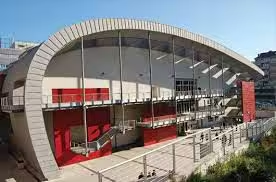
The pre-conference will take place at Roma Tre University, Rome, Italy, on January 21st. Young scholars are highly encouraged to apply to the call for abstracts. If selected, you will be invited to present your work. Selections will be made based on merit (partial travel stipends, and accommodation will be available for selected participants).
What are the real drivers of stable and equitable economic growth? In an era of inflationary pressures, shifting global value chains, and geopolitical realignments, the classic questions of political economy are more relevant than ever. The interactions between wage-setting, industrial policy, and macroeconomic management are at the heart of contemporary debates on resilience, distribution, and development.
This is your chance to engage directly with the core themes of the conference in a collaborative setting. We want to foster a vibrant discussion on how institutional power, strategic policy, and demand management shape our economic future. Join us for a day of in-depth discussion, constructive feedback, and networking with the next generation of political economists.
We are looking for contributions that critically engage with the conference’s main themes:
🛠️ Wage Regimes and the Balance of Power
How do labour institutions shape economic outcomes? We welcome papers on wage regimes, the resilience of collective bargaining,
The Keynesian Working Group is happy to invite early-career researchers, PhD candidates, and advanced Master’s students to a dynamic pre-conference event ahead of the 9th ASTRIL International Conference on “Wage Regimes, Tariffs and Economic Growth.”
The pre-conference will take place at Roma Tre University, Rome, Italy, on January 21st. Young scholars are highly encouraged to apply to the call for abstracts. If selected, you will be invited to present your work. Selections will be made based on merit (partial travel stipends, and accommodation will be available for selected participants).
What are the real drivers of stable and equitable economic growth? In an era of inflationary pressures, shifting global value chains, and geopolitical realignments, the classic questions of political economy are more relevant than ever. The interactions between wage-setting, industrial policy, and macroeconomic management are at the heart of contemporary debates on resilience, distribution, and development.
This is your chance to engage directly with the core themes of the conference in a collaborative setting. We want to foster a vibrant discussion on how institutional power, strategic policy, and demand management shape our economic future. Join us for a day of in-depth discussion, constructive feedback, and networking with the next generation of political economists.
We are looking for contributions that critically engage with the conference’s main themes:
🛠️ Wage Regimes and the Balance of Power
How do labour institutions shape economic outcomes? We welcome papers on wage regimes, the resilience of collective bargaining, the fight for real wages against inflation, and the link between wage policies, aggregate demand, and productivity. How is workers’ power being reconfigured in the face of new technologies and market structures?
🏭 Industrial Policy and Trade in a Fragmenting World
With the return of tariffs and reshoring strategies, what makes for an effective industrial policy? We encourage analyses of sectoral targeting, the role of the state in fostering innovation, and the interaction between trade dynamics and domestic development. How do these strategies impact competitiveness, social welfare, and long-term investment?
💸 Macroeconomic for Structural Change
How can fiscal and monetary policy be designed to stabilize demand and promote sustainable growth? We seek contributions on the effectiveness of countercyclical policies, the distributive consequences of public investment, and the coordination of macroeconomic tools with industrial and wage policies.
How to Apply:
Please submit your application by the 5th of December via the application button.
Your application should include:
– A 300 words abstract outlining your research question, methodology, and expected findings.
Selected participants will be notified by the 12th of December. Limited travel grants as well as accommodation may be available.
Key Details:
Event: YSI Pre-Conference @ the 9th ASTRIL Conference “Wage Regimes, Tariffs and Economic Growth”
Date: 21st of January
Location: Department of Economics, Roma Tre University
Important Dates:
– Abstract submission by the 5th of December
– Acceptance Notification by the 12th of December
– 9th ASTRIL International Conference: January 21-23, 2026