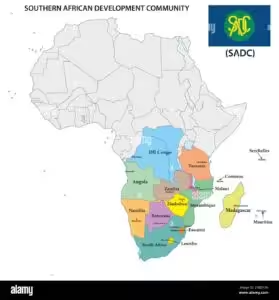
The question of African economic development is enduring. With 32 of 44 Least Developed Countries (LDCs) being in Africa. It is, therefore, imperative that scholars, specifically economic historians contribute to conversations around the question of Africa’s stalled development. In this regard, the symposium will examine the monetary component of economic development in Africa, bringing together select scholars working on the Southern African region to explore the monetary connections and disconnections in the development of the economy of the region. In collaboration with scholars and speakers from the Universities of Glasgow, Muzuzu in Malawi, Midlands State University in Zimbabwe and the Universities of Pretoria and Free State in South Africa, the project will assemble scholars of Southern African economic history who hitherto work in silos. The aim is to assemble scholars that will work towards a larger monetary project that will propel the advancement of the study of the economic history of Africa, with the goal of making historical connections to the enduring economic challenges the region faces. Thirdly, the symposium will afford scholars the opportunity to discuss relevant/topical national monetary issues impacting economic developments with the aim of (a) identify and brainstorm towards writing research grant proposal(s) for an in-depth study of money and economy making in Africa across different countries and epochs (b) discuss parameters for individual journal articles and book chapters for academic publication in high impact journals and reputable publishing houses.
It is the broader objective of the symposium to discuss the expansion of the
The question of African economic development is enduring. With 32 of 44 Least Developed Countries (LDCs) being in Africa. It is, therefore, imperative that scholars, specifically economic historians contribute to conversations around the question of Africa’s stalled development. In this regard, the symposium will examine the monetary component of economic development in Africa, bringing together select scholars working on the Southern African region to explore the monetary connections and disconnections in the development of the economy of the region. In collaboration with scholars and speakers from the Universities of Glasgow, Muzuzu in Malawi, Midlands State University in Zimbabwe and the Universities of Pretoria and Free State in South Africa, the project will assemble scholars of Southern African economic history who hitherto work in silos. The aim is to assemble scholars that will work towards a larger monetary project that will propel the advancement of the study of the economic history of Africa, with the goal of making historical connections to the enduring economic challenges the region faces. Thirdly, the symposium will afford scholars the opportunity to discuss relevant/topical national monetary issues impacting economic developments with the aim of (a) identify and brainstorm towards writing research grant proposal(s) for an in-depth study of money and economy making in Africa across different countries and epochs (b) discuss parameters for individual journal articles and book chapters for academic publication in high impact journals and reputable publishing houses.
It is the broader objective of the symposium to discuss the expansion of the study of African economic history across Universities in Africa which has declined over the years resulting in the production of much fewer experts in the field at a time they are most required. Scholars like Grieve Chelwa (2021, 2025) and Ndongo Samba Sylla (2025) have revealed the disparities inherent in the economic knowledge on Africa produced by Africans in relation to those produced by non-Africans especially those in the North, with the latter producing more knowledge often skewed in their favor. Studies have also shown that various economic indices used to measure economic progress for African economies are inapplicable making policy prescriptions equally inadequate in dealing with the unending African development problem [see for example, M.S Morgan (2011, 2018), Alden Young (2017), Alden Young and Tinashe Nyamunda (2025)]. Narrowing the continent to the Southern African region, the symposium builds and expands on an earlier YSI workshop organised by Geraldine Sibanda and Alessandro de Cola, titled Money and Monetary Institutions in Africa with a dossier now published in the Southern Journal of Contemporary History (2025). The symposium, therefore, seeks to provide a thinking platform for a wider group of economic historians to examine monetary developments in the region to not only contribute to the dwindling number of Africanists studying African economic developments, but to map out a way forward to enable scholars to carry out in-depth studies on the region so as to produce well-researched and relevant findings.
The themes to be examined will include the following:
- Taxation, Banking and Finance
- Financial inclusion
- Monetary Authorities: Currency, Central Banking and Currency Boards
- Imperialism of Free Trade
- International Financial Institutions and Global Monetary Architecture
- Economic Integration and Monetary Unions
- Personalities in Money and Economy-Making in Africa