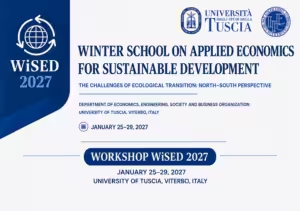
About WiSED
The Winter School on Applied Economics for Sustainable Development (WiSED) 2027) marks the second edition of this international academic initiative. Together with the Summer School on Applied Economics for Latin America (EVEAAL), WiSED forms part of a broader academic network dedicated to building an international community of scholars interested in applied economics, economic development, and sustainable development from heterodox perspectives.
Both initiatives share a common vision: to create lasting academic networks by bringing together students, early-career researchers, and senior scholars in an environment that encourages learning, collaboration, and the exchange of ideas. Rather than being isolated training events, WiSED and EVEAAL aim to foster a vibrant international community that promotes long-term research collaborations, interdisciplinary dialogue, and the development of new generations of researchers committed to addressing the economic and social challenges facing Latin America and other developing regions.
WiSED 2027 is jointly organized by the Faculty of Economics, University of Tuscia (UNITUS) and the Institute of Economic Research of National Autonomous University of Mexico (UNAM).
WiSED was conceived as a space for dialogue among scholars, students, and researchers interested in understanding the challenges of economic development and sustainable development from a heterodox perspective. While the School welcomes intellectual diversity, its academic identity is grounded in traditions such as Latin American Structuralism, Post-Keynesian Economics, Institutional Economics, Ecological Economics, Feminist Economics, and other critical approaches that seek to understand development beyond conventional frameworks.
About WiSED
The Winter School on Applied Economics for Sustainable Development (WiSED) 2027) marks the second edition of this international academic initiative. Together with the Summer School on Applied Economics for Latin America (EVEAAL), WiSED forms part of a broader academic network dedicated to building an international community of scholars interested in applied economics, economic development, and sustainable development from heterodox perspectives.
Both initiatives share a common vision: to create lasting academic networks by bringing together students, early-career researchers, and senior scholars in an environment that encourages learning, collaboration, and the exchange of ideas. Rather than being isolated training events, WiSED and EVEAAL aim to foster a vibrant international community that promotes long-term research collaborations, interdisciplinary dialogue, and the development of new generations of researchers committed to addressing the economic and social challenges facing Latin America and other developing regions.
WiSED 2027 is jointly organized by the Faculty of Economics, University of Tuscia (UNITUS) and the Institute of Economic Research of National Autonomous University of Mexico (UNAM).
WiSED was conceived as a space for dialogue among scholars, students, and researchers interested in understanding the challenges of economic development and sustainable development from a heterodox perspective. While the School welcomes intellectual diversity, its academic identity is grounded in traditions such as Latin American Structuralism, Post-Keynesian Economics, Institutional Economics, Ecological Economics, Feminist Economics, and other critical approaches that seek to understand development beyond conventional frameworks.
Particular attention is given to Latin America and other developing economies, where persistent structural constraints, productive heterogeneity, inequality, climate change, and the energy transition pose complex policy challenges requiring both theoretical innovation and rigorous empirical analysis.
Objective
WiSED 2027 aims to bridge economic theory and quantitative methods by offering participants an intensive learning experience that combines conceptual reflection with practical research tools.
Unlike traditional summer or winter schools that focus exclusively on either theory or methodology, WiSED is structured around the idea that empirical methods acquire their full value only when they are informed by solid theoretical foundations.
Each day is therefore organized around two complementary components:
- Morning sessions, where internationally recognized scholars present theoretical and policy-oriented perspectives on contemporary development challenges.
- Afternoon methodological workshops, where participants receive intensive hands-on training in a quantitative method and learn how that technique can be applied to answer the theoretical questions discussed during the morning sessions.
This structure enables participants not only to learn advanced empirical techniques but also to understand why, when, and how these methods should be used in the analysis of development, sustainability, and structural change.
The program concludes with the WiSED Workshop, providing participants with the opportunity to present their own research, receive comments from leading scholars, and exchange ideas with colleagues from different countries and disciplines. Participants will also be invited to indicate whether they wish to submit their work for consideration in a Special Issue associated with the event, subject to the journal’s standard peer-review process.
Official Language
English
Venue
University of Tuscia (UNITUS)
Università degli Studi della Tuscia | Sito Ufficiale
Viterbo, Italy
Who Should Apply?
WiSED welcomes:
- Master’s and Ph.D. students.
- Postdoctoral researchers.
- Early-career academics.
- Researchers interested in sustainable development, structural change, industrial policy, environmental economics, ecological transition, applied macroeconomics, and related fields.
The School particularly encourages applications from participants interested in heterodox economics, especially those working on the challenges faced by Latin America and the Global South, while remaining open to researchers from all regions seeking to engage in interdisciplinary dialogue.
-
Application deadline: 15 October 2026
-
Notification of selected participants: 1 November 2026
Young Scholars Initiative (YSI)
In collaboration with the Young Scholars Initiative (YSI), WiSED will organize a Colloquia designed to strengthen the participation of young researchers within the broader Winter School.
Selected YSI participants will take part in both the Colloquia and the main WiSED activities, promoting interaction between young scholars and internationally recognized researchers.
Partial financial support is expected to be available through YSI (fourthcoming).
Academic Structure
Part I. Morning Sessions
Theory and Development
Each morning will feature plenary lectures delivered by distinguished scholars from different heterodox traditions. These sessions will examine contemporary debates on:
- Economic development and structural transformation.
- Sustainable development and the green transition.
- Industrial and innovation policies.
- Climate change and energy transition.
- Productive heterogeneity and inequality.
- Blue Economy and Sustainable Coastal Development
- Contemporary debates in heterodox economics.
- Public policy challenges in developing economies.
Part II. Afternoon Sessions
Applied Quantitative Methods
Every afternoon participants will attend an intensive methodological workshop devoted to a specific quantitative technique widely used in applied economics.
The workshop will combine conceptual explanations, empirical applications, and practical exercises, allowing participants to understand how quantitative methods can be employed to investigate issues discussed during the morning lectures.
WiSED Workshop:
The challenges of ecological transition: North-South perspective
Wednesday, 27 January 2027
On Wednesday, 27 January 2027, WiSED will host the WiSED Workshop, a dedicated academic session where participants will have the opportunity to present their ongoing research in a collaborative and international environment.
The Workshop is designed to promote academic exchange by allowing participants to discuss their work with distinguished scholars and fellow researchers.
We invite participants to present their current investigations. Main topics:
Fiscal Sustainability and the Green Transition
- International Financial Architecture and Access to Green Finance.
- The Role of Public and Multilateral Finance in Supporting a Just Transition.
Trade, Technological Dependency, and the Reconfiguration of Global Value Chains
- Impacts of Decarbonization on Export Structures Reliant on Natural Resources.
- Industrial Policy Strategies for a Green Transformation under External Constraint.
Demand-led Growth and Ecological Transition
Just Transition, Employment, and Inequality
- Assessing the Potential of Green Sectors to Absorb Informal and Precarious Labor.
Climate Change, Debt, and Macroeconomic Resilience
- Economic Vulnerability to Climate Disasters.
Political Economy of the Green Transition
- Distributional Conflicts and Institutional Coalitions in the Green Transition.
Blue Economy and Sustainable Coastal Development
- Sustainable Management of Marine and Coastal Resources.
- Coastal Resilience and Climate Change Adaptation.
- Socioeconomic Impacts of Climate Change on Coastal Economies and Communities.
- Blue Finance and Policies for Sustainable Ocean-Based Development.
Participants wishing to present a paper will be invited to submit an extended abstract in advance. During the registration process, applicants will also be able to indicate whether they are interested in having their completed paper considered for publication in a Special Issue associated with WiSED 2027. Submission to the Special Issue will be entirely voluntary and subject to the journal’s standard editorial and peer-review procedures.
Follow us: https://www.instagram.com/eveaal_summerschool/
A Unique Learning Experience
WiSED is more than a winter school. It is an international forum that connects heterodox economic thinking, applied quantitative methods, and policy-oriented research to contribute to a deeper understanding of sustainable development challenges in Latin America and other developing economies.
By combining theoretical debate, methodological training, and academic exchange, WiSED seeks to build a vibrant community of young scholars committed to advancing innovative and socially relevant research on economic development.