
This transcript is from a keynote delivered at the 2025 Berlin Summit, hosted by Forum New Economy at the historic Stober Estate. The summit brought together international experts to explore how industrial, climate, and globalization policies can be reimagined for a fairer and more resilient future—building on the momentum of last year’s Berlin Declaration. YSI was grateful to take part both this year and last, and we deeply appreciate Forum New Economy’s guidance in helping us think more clearly and courageously about the challenges ahead. Watch the talk on YouTube here.
Keynote speech by Adam Tooze | 16 June 2025, Berlin.
“The question Thomas Fricke and the team posed—“Towards a new world order: who will now work it out?”—cannot help but preoccupy us. But I want to push back on some tendencies we have within ourselves that are triggered by this question, and instead urge us to think differently about how we think about the problem.
I don’t have any simple answers for this question. I’ll suggest the direction in which some answers might lie. But I want, above all, to think about this question of order as such.
For obvious and good reasons, at this current moment, we crave an answer to this question. And it’s both a forward- and backward-looking discourse. If you conjure up something like a new world order, you can hardly avoid talking about an old one — the last one.
For international relations and diplomatic people, of course, that’s the end of the Cold War. But for economists, it’s Bretton Woods. And almost in an obsessive way.
It’s this obsession that I want to spend five minutes or so coming to terms with. I think you could, in fact, write a rather interesting paper about The Guardian’s coverage of new Bretton Woods schemes in the current moment, so frequent are they.
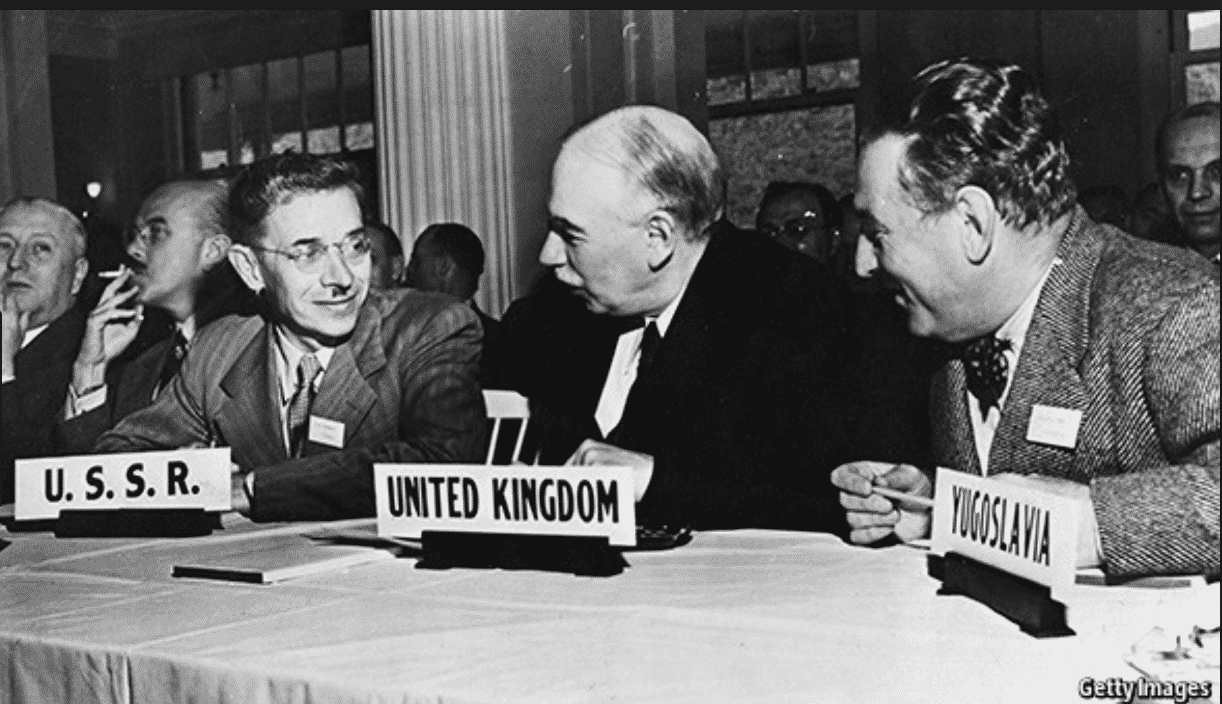
So what was it? It was the moment in 1944, in the summer of ‘44, at which a map of the world—the economic and currency system—was shaped by key figures. Charismatic figures. Notably White for the Americans and John Maynard Keynes for the British.
And last year, because of the 80th anniversary, there was a rash of meetings on a new Bretton Woods. And there were reasons for this. There was already then the looming prospect of a disruptive Republican presidency. But it was also already clear under the Biden team — even with the most cooperative, Atlantically-minded, globally-minded group of Democrats that we could possibly have hoped for at this moment — that there were profound tensions in the global economy.
There was pressure from the Global South to think of a new system that would work better. And it was clear that the rise of China and Russia’s aggression were putting what we had taken for granted as the post–Cold War system under massive pressure.
And now, of course, things have turned out far more dramatically than anyone imagined last year. I think that’s fair to say. Even those of us who were most pessimistic about a Trump presidency did not quite have this on our bingo card — the simultaneous assault on the trading system in the most capricious and arbitrary way any of us could have conceived, and a fairly systematic attack on foreign investment and the value of the dollar — more systematic than many of us would have credited.
And in light of this, it might seem almost perverse to engage in the exercise I’m suggesting this morning — which is to ask the question of why we might be looking for a new world order. I mean, compared to the nonsense, compared to the craziness that’s all around us — obviously we want a new world order, right?
But as obvious as that answer seems, I want to persist with this question. What is it, from a progressive point of view, that we associate with this idea of a world order — so much so that we ask to know how a new one will emerge, and who will make it?And why, in so many minds, is this associated with the Bretton Woods moment?
Because thinking like this is historical. And it does, I think, repeatedly cluster around this term. And it’s useful to use that habit of mind as a kind of diagnostic.
And at one level, you could say it’s obvious: it’s a series of goods, a series of things we value. Order as opposed to disorder. Intelligibility versus chaos. There’s almost an aesthetic side to it. Look, we got the economy under control. We fulfilled the dream of making this untransparent and opaque thing transparent.
There’s a promise of security versus insecurity. And the promise, perhaps, to the wider population of safety, a theme that’s come up in many conversations, for instance, about populism. There’s a promise (if not of actual fairness) then of something like a rules-based order. Some notion of the rules of the game. A kind of procedural justice, at least. There’s a functional claim that a system like this is more predictable, and that this boosts investment, establishes security, reduces uncertainty. An argument that runs through a large body of econometrics.
Remember those studies done during the first Trump term by IMF teams of economists, who actually showed a measurable effect on global investment from Trump’s early morning tweeting? But it’s an argument that, say, in the German social theory tradition goes back to Max Weber.
Then I think there’s something else that’s appealing about the Bretton Woods moment in particular, which is the sense that, in the face of the chaos of history, it is a moment of agency. A moment in which smart people sat around and came up with a design.
And of course for people like this (this is us) this is profoundly seductive. Because it’s so difficult to avoid the kind of play of mind where we imagine ourselves there, issuing the manifesto that feeds into the German delegation that goes to a new Bretton Woods, somewhere, where this will all be sorted out.
So it’s a moment of agency. But it’s also—and I think this is key—it’s also a moment of wisdom. Because it’s not just agency; it’s agency founding order. It’s self-constraining agency. It’s an agency that doesn’t just, in a muscle-bound way, stamp its interests on the world. It’s an agency that checks itself.
And this, I think, is what makes the Bretton Woods moment so inspiring—that at the height of their powers, Britain and the United States, at the end of World War II, decided to build a system rather than simply power on through.
And these are all good things. But the way in which they cluster around Bretton Woods—and the way that Bretton Woods, 80 years later, serves as a kind of totem—some might even say, less kindly, a comfort blanket for thinking about international economics—puts me in mind of something that, in another context, I’ve called financial fiction, or fin-iction.
You might also call it a fairy tale.
Fairy tales, famously, have many functions. But we don’t turn to them for practical advice, unless your problem is wolves dressed as little old ladies, or beautiful princesses who’ve been asleep for a thousand years, or magic beans your son brought back from the market after trading your family’s only cow.
So to my mind, the Bretton Woods model does need some examination.
And I’m actually going to summon, very briefly, a whole team of people to help us think through what’s at stake here — a psychologist, a historian, a political economist, a journalist… and Friedrich Nietzsche. A psychologist would ask: why this endless return to this foundational moment? What does it anchor? What are we papering over?
One telling slip you often hear — especially in German-accented discourse — is misplacing the date of Bretton Woods. It’s often referred to as a post-war agreement, whereas in fact, it was an agreement done between D-Day and the Soviet breakthrough against Army Group Center in Operation Bagration. It was a moment in which we found the notion of a benevolent American power.
You might rather crudely refer to this as Germany’s “American daddy complex,” right? This sense that there is a benign American hegemon there to hold the ring. That requires a simplified story about the origin of American power, which Bretton Woods helps to provide.
And after the psychologist, we turn to the historian. If Harold James is in the room — one of the preeminent historians of Bretton Woods — what he’ll tell you is that far from being a “and then they lived happily ever after” kind of story, Bretton Woods is really just one disaster after another.
There’s the conference in ‘44. Then there’s the UK currency crisis of ‘47, which postpones it. The Marshall Plan is actually Plan B to avoid having to implement Bretton Woods. Then there’s the devaluation of sterling and all other European currencies to make them more competitive — which was a huge shock to their systems. Then Plan D, which is the European Payments Union between 1950 and 1958.
And Bretton Woods, as originally conceived, isn’t actually introduced until 1958 — which requires a military coup and the installation of the Fifth Republic in France. And it’s Jacques Rueff’s plan, in cooperation with de Gaulle, that enables France to join Bretton Woods. By the early ‘60s, the system is under so much stress that they have to invent swap lines as the plaster that will keep it alive. By ‘67, it’s having its first big business cycle problem. And in ‘71, the American president suspends the gold convertibility of the dollar.
So if we did get a Bretton Woods III — and I’ll explain in a moment why I say III — we’d launch it next year, implement it in 2040, and it would fail by 2051. That’s what a historian would tell you about Bretton Woods as an actual example.
And then you’d have to ask yourself: well, how plausible is the functional story? If this is the real history of Bretton Woods, what are the chances that — compared to reconstruction, technological catch-up, a new social bargain, European integration — this fragile currency system was the main driver of economic growth with which it’s so often associated?
Clearly it makes some difference. It could have been much worse — American trade policy could have been entirely counterproductive, which it wasn’t.
But this is not the substance of an effective argument about economic growth.
And the funny thing is, if you actually talk to political economists about this, they’ll tell you there’s no reason to be surprised. Because they’ll say large-scale organizations of this type are beset by two foundational problems.
One is original sin — the problem of great, powerful actors binding themselves effectively against their own sovereignty.
So very unsurprisingly, insofar as the United States — the dominant player in ‘44 — was bound by the system, the binding was very thin. The U.S. retained extraordinary autonomy. The dollar was pegged to gold, and everyone else was pegged to the dollar. The Americans received exorbitant privilege. And the system starts when the Americans say it starts — and ends when the Americans say it ends.
That’s the Bretton Woods system. That’s the fundamental politics of it. And this is where we bring Nietzsche in.
So why would anyone else agree to be part of this system? Because they’re weak, and powerless, and resentful. That is the position of the Nietzschean subordinate — the position of Nietzsche’s “Christian,” who accepts Christianity because it protects them — powerless people — against the wrath of real power.
That is why other people sign up to orders given by capricious major powers: because orders and rules provide you with some protection. But of course, the real problem with resentful subordinates within dominant systems like this is… their resentments are real.
And so your second problem is free-riding. Subordinate players within fixed systems — with dominant players — are always going to be subject to the risk of dramatic free-riding. And we hardly need to emphasize that point here in Germany.
Because, if over the last 80 years there has been a persistent, successful, free-riding smaller player within a global system hegemonized by the United States, it’s this country here — the western bit, not this bit — the Federal Republic.
Massive surpluses under Bretton Woods in the 1960s, which contributed materially to its disintegration. And of course, the notorious free-riding under NATO since the 1990s.
Now, the Germans may say that’s sensible defense policy — because they’re surrounded by friends. But from the American point of view, this looks like free-riding. And that’s the scandal which they’re calling in now.
In fact, if you ask yourself: how does Germany behave when it’s powerful? Think about the eurozone. See what its track record is there.
In the 1970s, when people wanted the Deutschmark to be the reserve currency, Bonn and Frankfurt did everything conceivable to prevent that from happening. One of the strategies — to put it politely — was the eurozone.
And we all know, if we’d been meeting here ten years ago as a group of progressive economists thinking about the eurozone, many of us in the room would have been thinking — and maybe even wishing — “if only they had created the eurozone without the Germans in,” right?
One of the peculiarities of asking the question of economic order and its future now in Germany is: if there is somebody out there planning a new world economic order, they may not invite the Germans.
Because after the last 80 years, if you had to think of an uncooperative player — highly self-righteous, quite successful, very bad at macroeconomics — that you didn’t want to have as part of your effort to craft a global order, Germany would be pretty high on your list. And part of the project of our group here, after all, is to try to civilize German macroeconomic and economic discourse to the point at which that might no longer be true.
I think, if we’re honest with ourselves, that’s clearly part of our underlying agenda here. That’s what we’re trying to do. And nevertheless… here we are. Asking this question.
We’ve spoken to the psychologist. We’ve spoken to the historian. We’ve spoken to the political economist. We’ve spoken to Nietzsche. And we’re still asking this question — in Berlin, in 2025, on this day, on this morning — given what’s going on in the world.
At this point, I’m summoning the journalist. Because the journalist is just going to ask us one thing: “Now?” Now you want to talk about global economic order? Does this look like a moment when people want to do global economic order? No. This is a moment of discretionary violence.
It’s a moment of discretionary choices — for disruption. Think about it: Putin’s invasion of Ukraine. Trump’s trade war. Brexit.
They all have sources of resentment that drive them — but none of those resentments determine the choice. Any more than Israel’s strategic difficulties — even if you are a convinced ethnonational Zionist — dictate the course it has gone down and dragged so many of the friends of Israel into complicity with mass murder and ethnic cleansing. And, this morning, outright aggression against Iran.
So this seemingly innocent question — “Hey Adam, towards a new world order, who will work it out?” — is actually a vertiginous, bloody void. This is not a moment for soothing bedtime stories. This is a moment to summon our wits to survive. Not to tuck the children into bed with a fairy tale — but to enter an ultra-stressful, first-person shooter game.
It’s as though we’re living inside a nightmarish, resto-modded fairy tale.
We’ve been eaten by the Big Bad Wolf, and we’re inside the stomach, waiting to know whether the huntsman will come and cut us out so we can escape to freedom.
And in that moment — we’re dreaming about new orders.
And that, I think, is escapism of the first order.
Now the thing about this—if you say this—it makes sense, I think. But if you say it in a European context (and I’m looking at Shahin here), another kind of thought begins to intrude on you, which is that all of this sounds familiar. All of this sounds like something that in fact we’ve been talking about for a while. We’ve been talking about sovereignty. Sovereignty means the ability to make your own rules, exists—as Carl Schmitt explained to us—in a dialectical relationship with order. Sovereign is the person who declares the exception. Sovereign is, however, also those who are recognized by other sovereigns as sovereign. So it exists in a kind of dialectic.
In that context, we’ve also spoken about strategic choice, alliances, deals as something that Europe needs to get into the business of. The agonizing thing is that this is both obviously the right answer, I think, and the right way forward—and essentially a still from the movie Groundhog Day, in which we continuously repeat the same video clip. Think of the blighted two-term presidency of Macron in Paris, who in 2017 first essentially articulated a set of ideas very much along the lines that I think we’re naturally led to, faced with our situation nine years later. And we all know the void, the vacuum into which those proposals for Europe, progress, and future landed—on the German side.
So I think what we have to reckon with at this point is though this train of thought I’ve taken you down today is compelling, we have—if we’re realistic with ourselves—also to recognize that we’ve been here, and we’ve been here for some time. And the answer has not come from Europe. And in fact, if we are still asking ourselves this question this morning in 2025, we actually already know the answer, which is: though we can see it, we’re not going to do it. Or we’re going to do it too late. This train has left the station.
Somebody a couple of days ago said, “Maybe it’s too late for the United States.” I find that a quite plausible, though horrifying, thought. What I worry about is: it may be true—too late—for Europe too. And in that case, where do we go next?
And this is what I want to end with. Well, I think we all already also know the answer to this question. We’re posing these questions as though we don’t know the answers. We know the answer to this question. And the answer, clearly, is China.
But then, when you say that out loud, you realize that you run up against an obstacle too. Which is that if you say China is going to create the new world order, you are both likely a warmonger—because this is the sort of thing that provokes the Pentagon into asking for more and more money—and also blindly unrealistic. Because I don’t know anyone who thinks they really know what’s going on in Beijing who thinks that’s the Chinese ambition—to create an American-style world order. It’s not on Beijing’s menu.
And this is where I would submit that this shift in language really helps us out. Because if it’s true that China is not in the business of creating a new American-style world order—it’s undeniably and obviously true that China is in the business of world ordering.
If China is not just simply inheriting the world the West made—including through imperialism—is China in the business of world making? Yes. It absolutely is. And it’s doing it right now in front of our eyes. So this transition is not just a sort of methodological call. It’s actually, I think, helping us to see better.
And with Brad Setser sitting in front of me here—how can I not talk about Bretton Woods II, which we skipped over? Because China, in the late 1990s, effectively created a new Bretton Woods autonomously by pegging its currency in an undervalued way against the dollar—a peg which is really quite hard to break. It has all sorts of nasty side effects in China itself, but they can manage those. It’s a way of asserting their sovereignty within this system.
If you ask about the global trading system, this data here—which you can barely see, I’m afraid, but it’s kind of impressive if you do get to see it up close—this is from another concerned observer, the Singaporean Monetary Authority, in the face of the Trump trade onslaught, trying to figure out: What the hell actually does drive trade?
And the brown bits in this are the bits which have some connection with the United States, and they’re almost all trade into the United States. The bit that’s most politically sensitive—the tail that’s wagging the global economic dog—is the dark blue bar. That’s roughly two and a half percent of global trade, and that’s Chinese exports to the United States. And it’s not even a rapidly growing part of this pie. So that gives you a sense of how disoriented our discourse has become.
Global trade is dominated by two key players: one really large bloc, which is EU trade within—that’s the big slice in the middle—and then a whole series of spiderweb networks around China, each one of which constitutes a set of connections I would act—an act of world making, an act of world ordering—that we have to reckon with, and that will shape the future.
Now, to reiterate: if you add up China’s foreign investment, its soft power, its technological links, its increasing military presence—does it add up to an American-style new world order? No. It clearly doesn’t. But that’s also a red herring. We have to stop thinking in those terms.
What it does constitute is a policy of connection. It may not be entirely consistent, but I do think it’s quite deliberate. And there is a rationale—or in fact, there are multiple different rationales—being developed in Beijing that organize and coordinate these different elements.
And if there’s one aspect of that which I think is really quite fascinating and quite new—it was really prompted to me by the agenda that was sent to me by the National Development Research Council that advises the State Council, so the state branch of the Chinese government. This is the subordinate branch, but the leadership of the Development Research Council are central committee members, so they’re tightly tied in.
And they were saying, “Well, of course, we’d love to talk to you about all the obvious things—about America and Europe and so on. But the challenge that is on our minds is the development, or the challenges, of large nations’ development on a global scale. This is the problem that we’re actually talking about.”
And that’s bland. And you could say, well of course they’re thinking about that. But I think it leads me to my final concluding point, which is that in so far as we know anything about this future that’s being shaped—it’s very likely that it’s going to be shaped by players, notably the Chinese, for whom this question—large national development—those are the three things that really dominate their agenda.
So it’s really quite remote from the concerns of the EU, which are post-national, medium-sized, and about sustainability. The large national development agenda is the one that the key players that are currently actively building out systems are going to be engaged in right now.
I think we’re all a little bit impatient with China claiming status as a developing economy. There are very poor parts of China—but it doesn’t make any sense. But unless we grasp that this is the focus—development is the focus—we don’t really understand what this program of world making is. We don’t know what this program of renewable energy is about. The thing that makes it novel is not that it constitutes an order or replaces the Americans, but that it’s actually about the realization of a program of development on the global scale—regardless of its consequences, which are spectacular when we think about global environmental balances and in terms of shifting the balance of power going forward.
Adam Tooze holds the Shelby Cullom Davis chair of History at Columbia University and serves as Director of the European Institute. In 2019, Foreign Policy Magazine named him one of the top Global Thinkers of the decade. His latest book, Shutdown: How Covid Shook the World’s Economy is on sale now.
Forum New Economy is a non-partisan platform founded in Berlin in 2019 with the aim of seeking new solutions and a new overarching paradigm for the major challenges of climate change, growing inequality and globalisation, as well as redefining the role of the state. It supports innovative researchers and brings together renowned experts with practitioners and the wider public.
