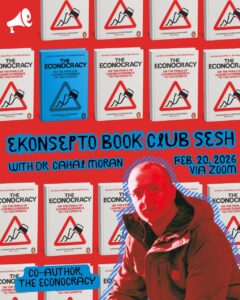
This project is a two-part holiday book club centered on The Econocracy: On the Perils of Leaving Economics to the Experts, organized by the YSI East Asia Working Group in collaboration with Ekonsepto (Rethinking Economics Philippines), a Philippine-based economic literacy initiative. The book club aims to create a public, accessible space for critical discussion on the role of economic expertise, technocracy, and public engagement in shaping policy across East and Southeast Asia.
The project consists of two online sessions:
-
December 20 — Introduction Session: An open conversation on why economics has become increasingly “expert-owned,” and how this affects democratic participation in the East Asian context.
-
February 20 (postponed from January 10) — Book Discussion: A collective reflection on The Econocracy, focusing on how its arguments resonate with issues of transparency, economic communication, and public literacy in the region. Our guest speaker is Dr. Cahal Moran, one of the book’s co-authors.
Dr Cahal Moran is a behavioural economist who is interested in understanding the impact that behavioural heuristics and biases have on our decisions in the real world. In practice, this means looking at household datasets to try and tease out the various nuances and asymmetries created by the quirks of our behaviour.
Cahal is especially interested in the economic effects of these behavioural quirks, such as their consequences for earnings and savings. For example, his PhD thesis measured the causes and consequences of reference
This project is a two-part holiday book club centered on The Econocracy: On the Perils of Leaving Economics to the Experts, organized by the YSI East Asia Working Group in collaboration with Ekonsepto (Rethinking Economics Philippines), a Philippine-based economic literacy initiative. The book club aims to create a public, accessible space for critical discussion on the role of economic expertise, technocracy, and public engagement in shaping policy across East and Southeast Asia.
The project consists of two online sessions:
-
December 20 — Introduction Session: An open conversation on why economics has become increasingly “expert-owned,” and how this affects democratic participation in the East Asian context.
-
February 20 (postponed from January 10) — Book Discussion: A collective reflection on The Econocracy, focusing on how its arguments resonate with issues of transparency, economic communication, and public literacy in the region. Our guest speaker is Dr. Cahal Moran, one of the book’s co-authors.
Dr Cahal Moran is a behavioural economist who is interested in understanding the impact that behavioural heuristics and biases have on our decisions in the real world. In practice, this means looking at household datasets to try and tease out the various nuances and asymmetries created by the quirks of our behaviour.
Cahal is especially interested in the economic effects of these behavioural quirks, such as their consequences for earnings and savings. For example, his PhD thesis measured the causes and consequences of reference points for household behaviour with the aim of contributing to the field literature on prospect theory. One of Cahal’s papers looks at asymmetries in savings behaviour and whether or not these can be attributed to loss aversion.
Since his PhD, Cahal has expanded his research to look at the impact of different biases on the behaviour of different groups. For example, he is currently working on a project which investigates the impact of choice overload on charitable giving among committed philanthropists, and preliminary results suggest that more choice actually encourages donations, which is contrary to choice overload. Joint work with Dr Ganga Shreedhar from PBS shows that the UK Government’s much-vaunted High Speed Rail 2 policy likely resulted from overly optimistic cost-benefit analysis.
Cahal is also a passionate advocate of economic pluralism and has long been a member of the student-led campaign Rethinking Economics. His book The Econocracy summarises their argument for pluralism and the importance of economic ideas in contemporary society. Cahal’s latest book, Why We’re Getting Poorer, analyses and explains issues such as inequality and cost of living crisis from a pluralist perspective. Finally, Cahal’s YouTube channel Unlearning Economics provides similar commentary on things that interest him.
Registration bit.ly/ekonsepto-theeconocracy
Participants sign up through the form above or join directly in our Telegram group chat. The event is open to the public, conducted in English, and designed to welcome participants with diverse backgrounds, not only those trained in economics.
The project is aligned with ongoing research and advocacy for more inclusive economic dialogue in East Asia, where rapid development, inequality, and institutional complexity make public understanding of economics especially vital. By grounding the discussions in both lived experience and emerging scholarship, the book club offers an entry point into themes such as institutional trust, governance quality, and democratizing economic knowledge.
This initiative also strengthens the YSI East Asia Working Group by expanding outreach, fostering cross-country exchange, and building a sustained community of young scholars and practitioners interested in pluralist, accessible economic thought. The collaboration with Ekonsepto amplifies visibility through an established public-facing platform, creating a bridge between academic inquiry and community-based education.
Through this project, we aim to cultivate a more participatory economic culture, one where young people across East Asia and globally can confidently engage in conversations that shape their societies.