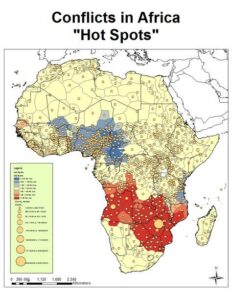
Conflict has been central in the long and chequered history of state-making in Africa. The creation of artificial borders, new monetary regimes and trade patterns from the 1500s occurred not without conflict and resistance amongst and between various population groups. The colonial plunder of African resources and relegation of Africans to the margins of the capitalist economy, as well as making Africans providers of menial, indentured/slave/unpaid/underpaid labour, also caused conflict. The ensuing liberation wars arising from such colonial domination and change ignited fierce resistance from colonial powers. To this day, decolonisation has existed in name as Africans continue to contend with the enduring legacies of colonial rule. Roaring among such legacies are conflicts of scarcity and inequality manifest on two parallel planes. Neocolonialism has reared its head as African countries chase economic development, and resource distribution in regional and international institutions remains uneven, causing enduring silent conflicts. In the case of countries in West Africa, for example, neocolonialism has not been silent at all, with the blatant involvement of countries of the North in violent resource conflicts and civil wars. On a second plane is an equally dangerous legacy borne of the othering by liberation movements. A legacy that alienates the masses to create room for the supposed liberation war heroes to eat from the feeding trough. It has manifested in ethnic tensions, authoritarian regimes, civil and transnational wars, and conflicts over natural resources and land. The threat to global peace due to the cyclical pattern of varied forms of
Conflict has been central in the long and chequered history of state-making in Africa. The creation of artificial borders, new monetary regimes and trade patterns from the 1500s occurred not without conflict and resistance amongst and between various population groups. The colonial plunder of African resources and relegation of Africans to the margins of the capitalist economy, as well as making Africans providers of menial, indentured/slave/unpaid/underpaid labour, also caused conflict. The ensuing liberation wars arising from such colonial domination and change ignited fierce resistance from colonial powers. To this day, decolonisation has existed in name as Africans continue to contend with the enduring legacies of colonial rule. Roaring among such legacies are conflicts of scarcity and inequality manifest on two parallel planes. Neocolonialism has reared its head as African countries chase economic development, and resource distribution in regional and international institutions remains uneven, causing enduring silent conflicts. In the case of countries in West Africa, for example, neocolonialism has not been silent at all, with the blatant involvement of countries of the North in violent resource conflicts and civil wars. On a second plane is an equally dangerous legacy borne of the othering by liberation movements. A legacy that alienates the masses to create room for the supposed liberation war heroes to eat from the feeding trough. It has manifested in ethnic tensions, authoritarian regimes, civil and transnational wars, and conflicts over natural resources and land. The threat to global peace due to the cyclical pattern of varied forms of scarcity and inequality breeding conflict and conflict breeding lack, societal and moral decay, vulnerability of mainly women and children has caused widespread intervention from international [e.g. United Nations (UN) and European Union (EU)] and regional organisations [e.g. African Union(AU), Economic Community of West African States (ECOWAS), and Southern African Development Community (SADC)] aimed at conflict resolution, with varying degrees of success. To decipher the contours of conflict that have influenced African history and reshaped historical narratives, the International Studies group of the University of the Free State and the Young Scholars Initiative will host a history bootcamp in Bloemfontein, South Africa, from 28 to 30 October 2026. The boot camp proposes relooking at African conflicts as, among other things, extensions and manifestations of local and international dominance, expressions of scarcity, subaltern voices, and quests for emancipation.
We therefore invite abstracts on the subjects listed below. However, papers tackling interesting aspects of conflict with a particular focus on Southern and Central Africa will be welcomed.
1. War and economic change
2. Trade and conflict
3. Natural resource conflict,
4. Conflicts arising from land and agrarian reform
5. Regional and international organisations in African conflicts
6. Transnational conflicts/Conflicts between states
7. War and military technology in Africa
8. Forced displacements
9. Women and Children in Conflict Situations
10. Peacekeeping, peacebuilding and conflict resolution
11. Personalities in African conflicts
Upon selection of abstracts, participants will be required to send complete draft papers following the style of the Southern Journal of Contemporary History. Final selection for attendance at the Bootcamp will be based on the quality of the draft papers. Successful papers will be published in a special issue of the Southern Journal of Contemporary History with Dr Mutale Tinamou Mazimba and Dr Geraldine Sibanda as guest editors. Successful articles and additional contributions will also be featured in an edited volume.
Early career scholars are PhD candidates and postdoctoral fellows with less than two publications in peer-reviewed academic journals. Participation in the Bootcamps is open to non-historians, provided that the proposed paper addresses the general theme of the Bootcamp and reflects historical methods. Participants must be based in institutions on the African continent. Limited funding is available for travel and accommodation.
Deadline for Abstract Submission: 15 May 2026
Submission of selected Draft papers: 30 June 2026
Final selection: 30 July 2026
For questions, contact isgbootcamp3@gmail.com.