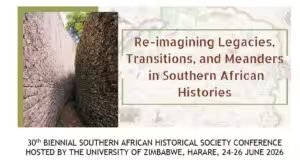
For several decades, southern Africa and the wider world have grappled with multifaceted social, political and economic legacies and transitions. These have manifested themselves in upheavals, increased armed confrontation, economic tensions, and a rise in localized social disorders. These transitions and meanders have configured and reconfigured structures and institutions of power, and are, undoubtedly, a product of historical processes, both anthropogenic and natural. Key moments in history have attracted varied historiographical responses from historians. The YSI- SAHS Pre-conference and main conference alike seeks to foster discussion about how historical transitions (international and local) have shaped the region’s histories and historiographies. This, we hope, will help shed light on how historical processes have been understood, experienced, and interpreted. The conference invites contributions from young scholars from various disciplines within humanities and social sciences. We welcome papers that employ a range of methodologies, including quantitative approaches to econometric modelling, statistical analyses, and an array of data-driven analyses; as well as qualitative research such as case studies, interviews, narrative analyses and ethnographic studies. The conference seeks to examine and re-examine the pertinent role of institutions and policies broadly conceived in shaping economic outcomes and social inequalities, as read with the broader thematic focus of this conference. Thus, we invite individual papers on the given broad theme and a wide range of sub-themes related, but not limited to:
• Legal histories: legacies, meanders, and changes in laws
• Statecraft and transitions: political and military change
• Protest cultures, everyday resistance and subversive politics
For several decades, southern Africa and the wider world have grappled with multifaceted social, political and economic legacies and transitions. These have manifested themselves in upheavals, increased armed confrontation, economic tensions, and a rise in localized social disorders. These transitions and meanders have configured and reconfigured structures and institutions of power, and are, undoubtedly, a product of historical processes, both anthropogenic and natural. Key moments in history have attracted varied historiographical responses from historians. The YSI- SAHS Pre-conference and main conference alike seeks to foster discussion about how historical transitions (international and local) have shaped the region’s histories and historiographies. This, we hope, will help shed light on how historical processes have been understood, experienced, and interpreted. The conference invites contributions from young scholars from various disciplines within humanities and social sciences. We welcome papers that employ a range of methodologies, including quantitative approaches to econometric modelling, statistical analyses, and an array of data-driven analyses; as well as qualitative research such as case studies, interviews, narrative analyses and ethnographic studies. The conference seeks to examine and re-examine the pertinent role of institutions and policies broadly conceived in shaping economic outcomes and social inequalities, as read with the broader thematic focus of this conference. Thus, we invite individual papers on the given broad theme and a wide range of sub-themes related, but not limited to:
• Legal histories: legacies, meanders, and changes in laws
• Statecraft and transitions: political and military change
• Protest cultures, everyday resistance and subversive politics
• The Anthropocene and environmental histories of southern Africa
• Economic transitions, crisis economies, and financial histories
• The political economy of mining and mining communities in southern Africa
• Nationalism and historical narratives: the weaponisation of history
• Digital Age (Artificial Intelligence, misinformation, deepfakes, and historical revisionism)
• Decolonizing history (Challenging Eurocentrism, indigenous perspectives)
• Gendered experiences of transitions, legacies, and meandering histories
Paper submissions should include an abstract (max 200 words) and a biographical statement (a brief paragraph of 100 words). Please submit online at https://forms.gle/cfSXdBbU17c74XSY8 by 31 March 2026. And email queries can be directed to preconference organizers Peter Uledi and Kelvin Gomera at peteruledy@gmail.com or kelvinlexcygomera@gmail.com. We intend to fund a limited number of young scholars within the region of South Africa.