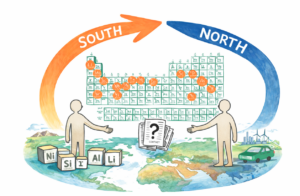
Strategic Minerals and Industrial/Regional Development from a Southern perspective
Workshop – University of Pisa
The so called- critical raw materials & minerals have become a cornerstone of the ongoing structural transformation of the global economy. New industrial policies involving decarbonization technologies (from renewable energy to electric mobility) are highly mineral-intensive, and governments across the world have responded by formalizing specific Critical Raw Materials (CRMs) agendas focused on security of supply and industrial competitiveness (for example, see EU Critical Raw Materials Act)
In resource-rich economies of the Global South, however, debates often go beyond “criticality” to emphasize strategic minerals: resources that are not only essential for the energy transition, but also potentially central to industrial development, social inclusion, and geopolitical positioning. Latin America is particularly salient in this context, given its diverse mineral endowments and the global relevance of producers such as Argentina, Brazil, Chile, Mexico, and Peru, including the countries that make up the so-called Lithium Triangle. However, the extraction of this materials also pose social and ecological challenges whose effects tends to be undermined.
Given the policy interest and public attention the Critical Raw Materials are having in northern areas, we see an increasing area of interest inside the disciplines of Economics and Social scienes to understand its process of extraction, monetizatino and distribution. Yet, the majority of frameworks lack an integration Southern, Northern, and Transnational perspectives.
Taking advantage of the visit of the argentinian
Strategic Minerals and Industrial/Regional Development from a Southern perspective
Workshop – University of Pisa
The so called- critical raw materials & minerals have become a cornerstone of the ongoing structural transformation of the global economy. New industrial policies involving decarbonization technologies (from renewable energy to electric mobility) are highly mineral-intensive, and governments across the world have responded by formalizing specific Critical Raw Materials (CRMs) agendas focused on security of supply and industrial competitiveness (for example, see EU Critical Raw Materials Act)
In resource-rich economies of the Global South, however, debates often go beyond “criticality” to emphasize strategic minerals: resources that are not only essential for the energy transition, but also potentially central to industrial development, social inclusion, and geopolitical positioning. Latin America is particularly salient in this context, given its diverse mineral endowments and the global relevance of producers such as Argentina, Brazil, Chile, Mexico, and Peru, including the countries that make up the so-called Lithium Triangle. However, the extraction of this materials also pose social and ecological challenges whose effects tends to be undermined.
Given the policy interest and public attention the Critical Raw Materials are having in northern areas, we see an increasing area of interest inside the disciplines of Economics and Social scienes to understand its process of extraction, monetizatino and distribution. Yet, the majority of frameworks lack an integration Southern, Northern, and Transnational perspectives.
Taking advantage of the visit of the argentinian scholar Martín Obaya (see bio below) to the University of Pisa, this in-person workshop aims to create a dedicated space for dialogue between students and scholars working from Northern and Southern perspectives on industrial development (in general), and/or Critical Raw Materials (in particular). The objective is not only to compare approaches, but to critically examine their complementarities, the blind spots, and their underlying assumptions, particularly in relation to mainstream frameworks that often marginalize or overlook Southern experiences and conceptualizations.
Given Martín Obaya’s extensive expertise on lithium governance and industrial development in Latin America, lithium will serve as a key empirical entry point to explore how different theoretical frameworks, policy concepts, and methodological approaches emerge when development is analyzed from a Southern perspective. At the same time, the workshop welcomes engagement with other strategic minerals (e.g. cobalt, copper, nickel) and broader clean-technology value chains aiming to contribute to industrial and regional development.
Core themes and guiding questions
We welcome master, PhD and post-docs students whose academic projects engage empirically and/or theoretically with one or more of the following lines of inquiry:
-
Policy strategies in southern resource rich economies to build domestic capabilities linked to clean technologies and related value chains.
-
Opportunities and obstacles for resource-based development strategies, including industrial and regional policy, innovation systems, and local value addition.
-
Geopolitical dynamics shaping critical mineral sourcing, diversification strategies, international partnerships and its effects.
-
ESG risks and governance associated with mineral extraction, including multi-level governance frameworks and due-diligence regimes.
-
Conceptual and methodological challenges in incorporating Southern perspectives into debates on industrial development and the energy transition.
Students who explicitly feel they might be missing “something” in their frameworks, or that seek to widen their theoretical, empirical, or geographical scope: this workshop is for you!
Workshop format
The workshop is conceived as an interactive working session, not as a conventional conference panel. Presentations will be limited to a maximum of five participants, to make space for extensive discussions of the work as well as further questions prepared by the discussants. Each participant will have time to present their project and we will dedicate time to discuss between the whole group about each case.
Participants will have the opportunity to:
-
Present and refine their central research questions and methodologies of their projects;
-
Receive and provide detailed peer feedback from a top southern scholar;
-
Discuss methodological and data challenges (qualitative, quantitative, and mixed methods);
-
Exchange sources of information (datasets, policy documents, corporate disclosures, fieldwork strategies) and frameworks/perspectives;
-
Identify opportunities for collaboration and longer-term North–South research connections.
Practical information
-
Date: 10th February, 2026
-
Format: In-person
-
Location: University of Pisa, Dipartimento di Economia e Management (Via Cosimo Ridolfi, 10)
-
Application materials: Abstract (max 1000 words) + short bio/motivation
-
Funding: Please note that no funding is available. Participants are expected to cover their own travel and accommodation costs.
About the convenor
Martín Obaya is a researcher at the National Scientific and Technical Research Council of Argentina (CONICET) and Vice-Director of the Centro de Investigaciones para la Transformación (CENIT) at the National University of San Martín. He holds a BA in Economics (University of Buenos Aires), a MA in International Relations (University of Bologna), and a PhD from Monash University.
For over a decade, his research has focused on the lithium mining industry, with particular attention to the development of technological capabilities, comparative governance frameworks across Latin America, and the evolution of multi-level governance models for responsible sourcing. His work bridges political economy, industrial policy, and sustainability studies.
The final aim of the event is to streghten north-south links in terms of theories, concepts, frameworks and, more importantly, people. Apply till 25 of January!