
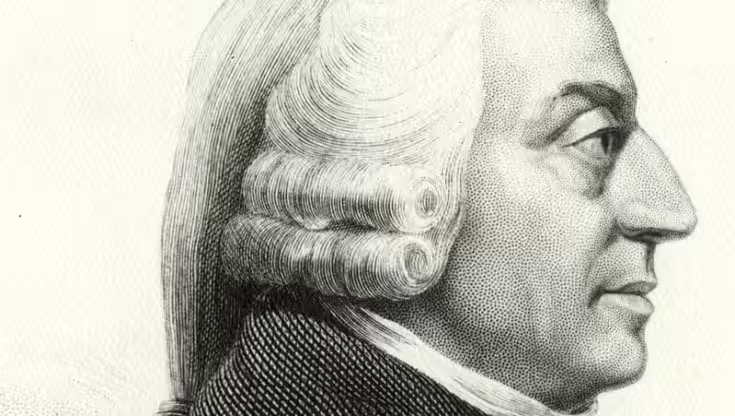
Adam Smith is usually read as a theorist; the architect of modern economics, whose Wealth of Nations laid down the foundations of market logic for the centuries that followed. But what if that reading misses his actual project? Smith has long been criticized for relying on the labor theory of value, a framework later economists found theoretically imprecise. Yet if Smith was not primarily building a general theory of value, the criticism loses its target. It is time to stop treating The Wealth of Nations as a theoretical textbook and read it for what it more plausibly is: a political economy analysis of a world in the middle of a major transition.
To understand Smith’s project, one must first look at The Theory of Moral Sentiments (TMS). Before turning to the Wealth of Nations, Smith focused on the behavioral foundations of society; what he saw as the underlying motivations of economic actors. With that foundation established, The Wealth of Nations takes on a different character. Smith was no longer working as a pure philosopher. He was an observer of a changing world and a policy advisor with a specific audience in mind.
The World Adam Smith Observed
Smith lived through the decline of the open-field system, in which peasant farmers worked scattered strips of land within large, communal, unenclosed fields. The enclosure of common land (accelerating through parliamentary acts across the mid-to-late 18th century) was one of the most consequential structural changes of his era. It converted land into a commodity, made investment in agricultural improvement profitable, while displacing large numbers of rural people from the land they had worked collectively.
Those displaced farmers moved to cities. Urban populations expanded rapidly; in places like Glasgow, the labor force grew at an unprecedented pace. People who had previously subsisted partly through access to common land now had to purchase food, which deepened market demand and accelerated the formation of what we might call an early middle class — a group whose interests were tied to trade, wages, and production rather than to mercantilist monopoly.
This urban workforce gave factories a new kind of resource: concentrated, specialized labor. This is what Smith observed at the pin factory; not an abstraction, but a concrete social reality unfolding around him.
Smith also saw that mercantilism was failing on its own terms. The pre-industrial world had been largely zero-sum: growth was slow, wealth was identified with gold, and trade was treated as a competition in which one party’s gain was another’s loss. Under this logic, buying French wine meant funding the French Navy. But the world was changing. Productivity growth, improvements in transportation and trade infrastructure, and the rise of a class of people who were simultaneously workers and consumers pointed toward a different kind of economy; one in which growth could improve welfare broadly, rather than simply redistributing an almost fixed stock.
Achieving that transition required dismantling mercantilist monopolies. That was Smith’s policy argument.
Adam Smith’s Project
In The Wealth of Nations, Smith undertook a concrete political economy analysis. He was less concerned with developing a general theory than with providing an account of his era in language his audience could use.
That audience was real and specific. Smith was a founding member of The Select Society (established 1754), a debating club for Edinburgh’s intellectual elite. He became an advisor to Charles Townshend, Chancellor of the Exchequer, and tutored the son of the Duke of Buccleuch beginning in 1764. He had credibility with politicians and aimed to influence British policy directly.
The labor theory of value, read in this light, was not an attempt to establish an economic principle. While it lacked scientific accuracy, it functioned as a rhetorical way of highlighting what was actually driving growth in his moment: labor migrating to cities and enabling specialization. Similarly, his breakdown of natural price into wages, rent, and profit mapped the primary market factors of the transition he was observing; wages as the labor market expanded, land rent as enclosure made land a commodity, and profit as the signal for investment and resource allocation.
His distinction between productive and unproductive labor served the same purpose. A modern pro-market economist might reject the distinction. Still, Smith’s framework was explicitly tied to the industrial growth driving his era and he was making a policy argument: stop governing like a gold-hoarding king and start building a productive system.
None of this means that Smith’s concepts (including the Invisible Hand or the division of labor) lack theoretical value in later debates. But those later applications are extensions, often well beyond Smith’s original intent. When Smith wrote about the division of labor, he was describing something he could see happening around him.
Why It Matters Now
Reading Smith as a transition-era commentator rather than a universal theorist offers a different perspective on his work. His example highlights a method of reading structural change clearly, identifying the economic interests of different players, and offering a policy attentive to the realities of his historical moment. Ultimately, even if Smith’s project lacks scientific precision, it remains a valuable method to learn from.
About the Author | Ehsan Mousavi is a graduate student in Economics and Data Analysis at the University of Bergamo, Italy, where his research focuses on political economy and monetary economics. He is a member of the Entangled Political Economy Research Network at the Mercatus Center and the Hume Society. His work was selected for the Mont Pelerin Society’s Hayek Essay Contest in 2024, and he has been published in the Washington Times and Donyaye Eghtesad.
