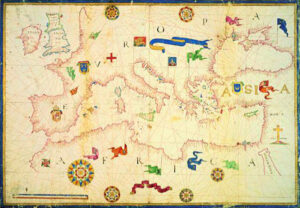
The Mediterranean has long been a crossroads of cultures, institutions, and economic systems, yet its historical development remains unevenly represented in the broader economic history literature. While the past decade has seen growing interest, this progress still falls short of the extensive scholarship devoted to Northwestern and Central Europe. This imbalance limits our ability to answer major questions in global economic history. Without systematic attention to Mediterranean experiences, we risk relying on overly narrow theoretical frameworks, overlooking the region’s vast diversity in political institutions, factor markets, human capital formation, and state-society relations.
A central challenge is the fragmented nature of historical data across Mediterranean countries. In many areas, the construction of long-run datasets on markets, land tenure, taxation, or human capital is still incomplete, often due to limited archival accessibility, systems heterogeneity or uneven scholarly attention. Overcoming these obstacles is essential for building a more comprehensive and comparative understanding of long-term economic development. One that integrates the complexities of the Mediterranean world into global debates rather than treating them as peripheral or exceptional cases.
With the generous support of the Young Scholars Initiative and the Figuerola Institute, this workshop seeks to address these gaps by fostering rigorous new research on the economic history of the Mediterranean region. We aim to create a forum where early-career scholars (predocs, postdocs, and early-career assistant professors), working with both quantitative and high-quality qualitative approaches, can present their work, exchange ideas, and situate their findings within broader Mediterranean and global trajectories. By
The Mediterranean has long been a crossroads of cultures, institutions, and economic systems, yet its historical development remains unevenly represented in the broader economic history literature. While the past decade has seen growing interest, this progress still falls short of the extensive scholarship devoted to Northwestern and Central Europe. This imbalance limits our ability to answer major questions in global economic history. Without systematic attention to Mediterranean experiences, we risk relying on overly narrow theoretical frameworks, overlooking the region’s vast diversity in political institutions, factor markets, human capital formation, and state-society relations.
A central challenge is the fragmented nature of historical data across Mediterranean countries. In many areas, the construction of long-run datasets on markets, land tenure, taxation, or human capital is still incomplete, often due to limited archival accessibility, systems heterogeneity or uneven scholarly attention. Overcoming these obstacles is essential for building a more comprehensive and comparative understanding of long-term economic development. One that integrates the complexities of the Mediterranean world into global debates rather than treating them as peripheral or exceptional cases.
With the generous support of the Young Scholars Initiative and the Figuerola Institute, this workshop seeks to address these gaps by fostering rigorous new research on the economic history of the Mediterranean region. We aim to create a forum where early-career scholars (predocs, postdocs, and early-career assistant professors), working with both quantitative and high-quality qualitative approaches, can present their work, exchange ideas, and situate their findings within broader Mediterranean and global trajectories. By bringing together young scholars and senior researchers working on diverse subregions and themes, the workshop intends to generate fresh insights into key topics such as divergence, integration, state capacity, fiscal systems, colonial legacies, technological change, and the long-term dynamics of markets and institutions.
The event will take place at the Social Sciences Department of the Universidad Carlos III de Madrid (UC3M), at the Getafe Campus on July 1, 2026. Participants will receive constructive feedback from leading economic historians at UC3M, Figuerola Institute, and other institutions. The keynote address will be delivered by Professor David Chilosi (King’s College London), whose work exemplifies the kind of rigorous, region-wide analysis this workshop seeks to promote.
The Young Scholars Initiative –an international network committed to supporting innovative research by graduate students and postdoctoral scholars– plays a central role in promoting interdisciplinary dialogue and fresh approaches to economic history. The Figuerola Institute, with its strong tradition in quantitative historical research, complements this mission through its commitment to methodological rigor and the integration of diverse social science perspectives. Together, these institutions provide the ideal platform for a workshop designed to broaden the geographical, methodological, and thematic scope of the field.
Scientific committee:
Laura Maravall (University of Alcalá)
Mª Carmen Pérez Artes (University of Almería)
Pablo Martinelli (UC3M)
Víctor M. Gómez-Blanco (University of Alcalá)